

University of Birmingham researchers 3D print continuous carbon fiber-reinforced silicon carbide composites | VoxelMatters

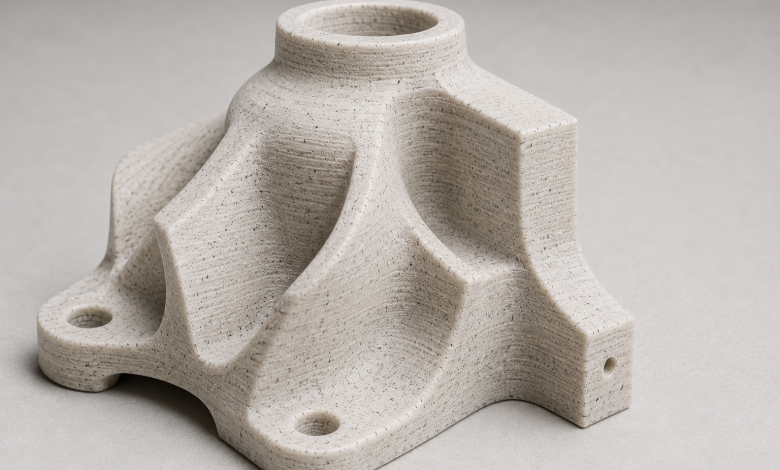
Researchers at the University of Birmingham have developed a 3D printing method capable of producing geometrically complex ceramic matrix composites (CMCs) reinforced with continuous carbon fibers — a material class long considered difficult and costly to manufacture through conventional means.
The study, authored by Daorong Ye and Jon Binner of the university’s School of Metallurgy and Materials and published in npj Advanced Manufacturing, focused on continuous carbon fiber-reinforced silicon carbide (Cf-SiC) CMCs. These materials can withstand highly corrosive environments and extreme temperatures, making them well-suited to aerospace, nuclear, and automotive applications. Traditional fabrication routes, however, have been constrained by high costs, limited flexibility in fiber placement, and a susceptibility to manufacturing and machining-induced defects that restrict geometric freedom.
A new fabrication approach
The Birmingham method embeds continuous carbon fibers simultaneously with the deposition of a SiC-based matrix during the printing process. Once printed, the green bodies undergo polymer burnout before being sintered into finished CMCs. Critically, the approach also allows for variable fiber-reinforcing structures within a single part — a capability that conventional manufacturing routes cannot readily offer.
For the AM industry, the significance lies in what 3D printing enables that traditional methods cannot: near-net-shape production of geometrically complex CMC parts, with the ability to tailor fiber orientation layer by layer. That degree of control over directional mechanical properties has direct relevance for components operating under demanding thermal and structural loads.
Implications for high-performance applications
SiC-based CMCs are already established in aerospace and nuclear sectors for their ability to maintain mechanical integrity under extreme conditions. A printing-based route to producing these composites with continuous fiber reinforcement — rather than the short-fiber or particulate reinforcements typical of additive approaches — represents a meaningful step toward expanding the design and production options available to engineers working with this material class.