Three companies, Cadence, Synopsys, and Siemens EDA, dominate chip design software. Their software takes you from chip specification to a manufacturable layout. As AI has rapidly advanced, so have their Electronic Design Automation (EDA) agents, all sporting notable improvements in 2026. The addition of a reasoning model helps drive that flow for Cadence’s ChipStack super agent, Synopsys’ AgentEngineer, and Siemens’ Fuse EDA AI agent, each with its own claims to fame. Cadence at Computex on June 1 said its agent reached what it calls Level 5 autonomy. Rob Knoth, Senior Group Director of Strategy and New Ventures at Cadence, told Tom’s Hardware Premium that the demo was “what we call bounded Level 5 in one domain,” with the bulk of super-agent tech at “I’d say advanced Level 4.”
Synopsys said its spec-to-RTL (Register Transfer Level) workflow shown on March 11 reached “L4,” and the company told Tom’s Hardware Premium it now claims L5 capabilities for its long-horizon agents. Siemens’ agent launched March 16 with “self-verifying” loops announced on July 26. Meanwhile, outside these big three, Empyrean’s chairman, Liu Weiping, stated on Sept. 9 that its agent cut a layout task from four weeks to one, according to the South China Morning Post.
While the claims about what these agents do are specific and now known, what they have measured is not. All of the claimed improvements to speed are the vendors’ or their customers’ own figures, with many “up to” or “early evaluation” caveats. These figures often measure different things against different baselines, and the only evaluator Synopsys named in July, AMD, has not provided analysis beyond an endorsement.
Latest Videos FromTom’s Hardware
From copilot to closure
In an evolving field, it can be difficult to hit a moving target, especially when the reported numbers measure different things. Some clarity is possible by following the distinct stages from human-only to human-reviewed agent autonomy. The agents fundamentally rely on existing technologies with known desired outputs for accurate evaluation.
Progress has so far followed three distinct generations. At Synopsys, by DSO.ai and reinforcement learning in 2020, generative AI capabilities with Synopsys.ai in 2023, and finally an open agentic AI stack from 2025–2026. All decisions must be validated by proven EDA engines, with the agent focused on evaluating intermediate results and determining subsequent actions. A model’s proposal is examined by an existing deterministic engine such as Xcelium, Jasper, Questa, Calibre, or Fusion Compiler within an iteration loop until final verification.
Measuring progress here does not follow a standard, but there are autonomy ladders with a general rating from Level 1 or L1 to Level 5 or L5 or, in Siemens’ case, no numbered level. Cadence, which uses levels, moves from optimization AI to conversational LLM, complex reasoning, agentic workflows, and then finally full autonomy, defined as taking a design from spec to verification “with minimal human intervention.”
Synopsys’ L framework goes from actions of single agents on a single design step to more complex ones with multiple agents, with further development focusing on adaptive learning and, ultimately, the agent’s ability to make decisions autonomously. The critical part for Synopsys is that “human engineers will and must always be in the loop.” Given the claims of progress, it’s clear that ladders, where they exist, are a form of marketing scaffolding that describes the same underlying architecture or loop.
Specification to verified RTL
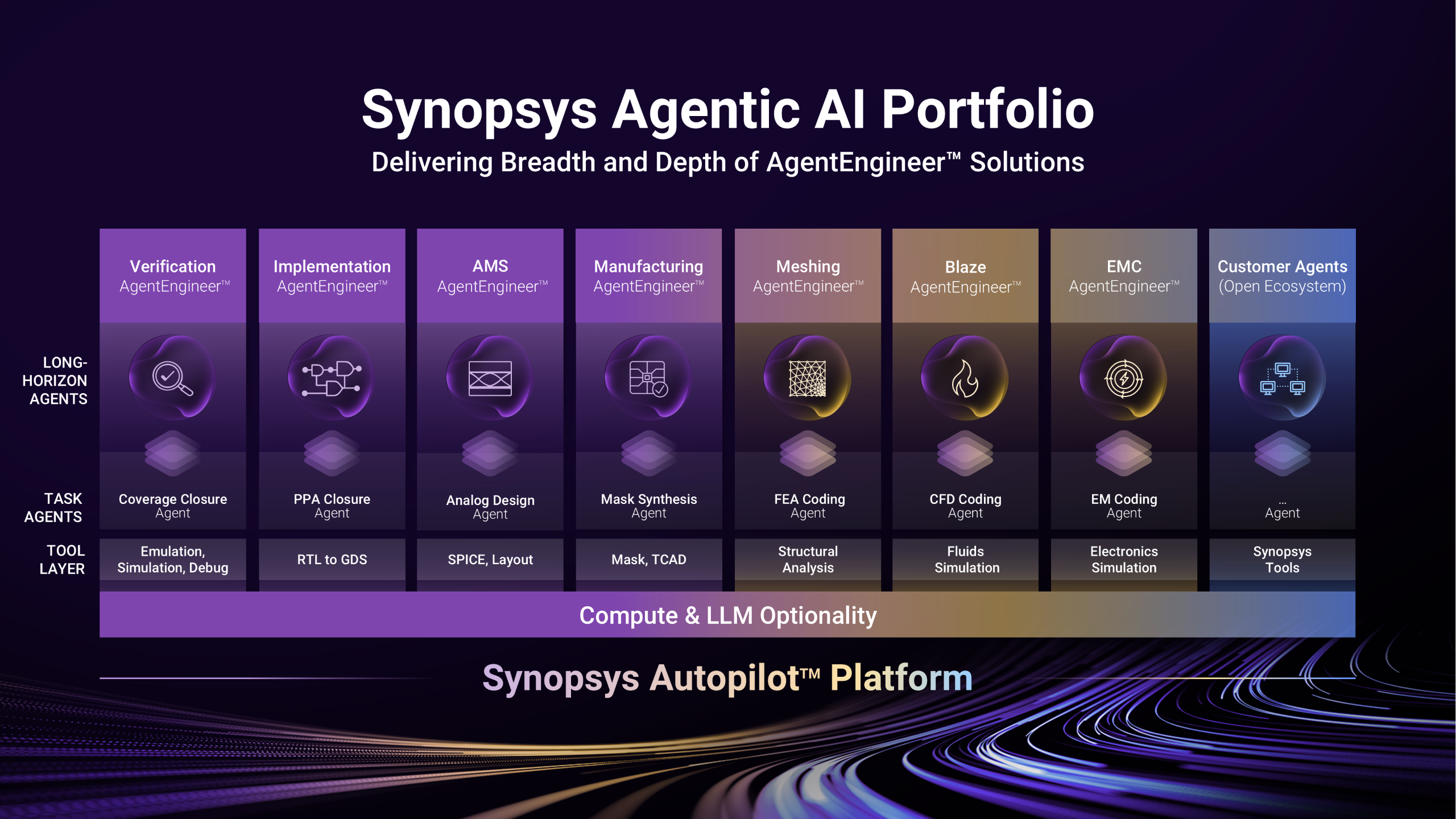
(Image credit: Synopsys)
The greatest claimed gains thus far are in the front-end design and verification stages, taking a specification from RTL to a verified design. This part of the process is a natural fit for LLMs, as the RTL, testbenches, and assertions are code. Where the loop used to wait on human analysis and input, the agents can run simulations in parallel and make decisions with fast, concrete pass-or-fail answers. These loops already existed and are prime real estate for agents to speed things up, with claimed orders-of-magnitude improvements by moving from human to agent on what is often the slowest part of the process, triage.
Getting from the chip specification to verified RTL code involves generating the code from natural language and formal specification, according to Synopsys’ March release. From there, the agents generate unit-level testbenches and engage in a verification loop. In July, Synopsys claimed RTL validation could be up to 50x faster with a 20% improvement in coverage, compared with its own non-agentic flow.
For Cadence’s ChipStack from February, the scope includes “autonomous RTL design, verification, and debug.” Named early users include Altera, Nvidia, and Qualcomm. ChipStack started as a Seattle startup that was acquired in November of last year after a multi-year integration with Xcelium and Jasper. In June, Cadence said RTL validation could happen over 40x faster, with each engineer using ChipStack agents “to run hundreds of dynamic simulations with Cadence Xcelium … reducing a typical five-week verification loop to less than a day.”
Siemens’ Questa One Agentic Toolkit, detailed in February, has five separate agents: RTL Code Agent, Lint Agent, CDC Agent, Verification Planning Agent, and Debug Agent. These work with mainstream AI coding applications including Claude Code, Cursor, and Siemens’ own Fuse. Akshay Aggarwal, senior director of engineering for MediaTek, noted “immediate and significant” gains. The numbers from Synopsys and Cadence should be read as the vendor’s own ratio comparison to the old loop, as regression loops are already automated. All three companies are now focusing on the decision-making process. For details on specific claims, refer to the table below.
Swipe to scroll horizontally
Vendor performance claims
Vendor
Claim
What it measures
Measured by
Date
Cadence
Over 40x; five weeks to under a day
One RTL validation loop
Not stated (Nvidia deployment)
June 1, 2026
Cadence
Up to 10x
Front-end design and verification tasks
Cadence
Feb. 10, 2026
Altera
About 10x “in some areas”
Verification effort
Altera, in Cadence’s release
Feb. 10, 2026
Synopsys
2x, up to 5x in select cases
Spec to verified RTL vs. a four- to six-month team effort
Synopsys
March 11, 2026
Synopsys
25% to 40%
Debug cycle time, early evaluations
Synopsys; AMD evaluating
July 27, 2026
Synopsys
Up to 50x, plus 20% more coverage
Time to validated RTL vs. its own non-agentic flow
Synopsys
July 26, 2026; restated Sept. 28
Fujitsu
10% to 30%
RTL code generation productivity
Fujitsu, in Synopsys’ release
Sept. 28, 2026
Synopsys
2x token efficiency
Tokens per task vs. a customer’s own agents on commercial harnesses
Customer-reported, via Synopsys
Sept. 28, 2026
Siemens
More than 10x; 5x to 10x lower token cost
Library characterization
Siemens
July 26, 2026
Empyrean
Four weeks to one
One circuit layout task
Chairman, via SCMP
Sept. 9, 2026
The back end
Things are tougher when you move from RTL verification to implementation. Outside of specific tasks that look like front-end loops, claimed gains are harder to come by. This phase deals with geometry and physics, not code, and the pace is limited by compute. Some tool runtimes are “days to weeks … just running the tool itself,” and a tool call that takes “hours to days” to return a value “really gives the AI industry a much different problem to solve,” Knoth said. Complex trade-offs remove singular pass-or-fail judgments, and mistakes later in the process become much more expensive. Earlier AI integration also already exists for this flow, so the agentic touch is more on experiment-running. This makes things cloudier.
Cadence’s InnoStack runs parallel experiments from synthesis to ECO execution. ViraStack, which is for custom and analog solutions, handles the design flow from drawing to simulation, optimization, and layout porting, with some customers “reporting 3–10x productivity improvements,” according to a report from Futurum in April.
Synopsys’ looping implementation agents, driving Fusion Compiler directly or through other platforms, help “reduce manual engineering effort,” according to AheadComputing, and Synopsys said they improve quality of results, including timing, power, and area.
Siemens Fuse, meanwhile, coordinates at least nine named tools, including Solido for custom IC design and verification, Aprisa for physical implementation, Calibre for signoff verification, and design-for-test with Tessent. Improvements vary, with Solido mentioned as improving characterization turnaround times by more than 10x and token costs by 5x to 10x, according to Siemens. One third party, STMicroelectronics, mentions that the Solido Layout Analyzer is helping “cut down the time we spend debugging complex design blocks by weeks,” according to Non-Volatile Memory Design manager Gianbattista Lo Giudice.
Empyrean, according to the SCMP’s September reporting, is shifting from “humans operating tools” to “humans commanding agents” with its agentic EDA platform. This platform would work with its partners’ agents. One claim is that 3D verification went “from two to three months to less than a month,” according to TrendForce reporting. Empyrean is the largest domestic EDA vendor in China and is state-controlled as of December 2024.
Self-checking agents
(Image credit: Siemens)
What we inevitably keep coming back to with agentic EDA is one simple term: trust. The agents must be trusted to varying degrees to check their own work. Important checkpoints are still verified by a human: “The crucial approval checkpoints are still going to be human-driven,” Anand Thiruvengadam, executive director of product management at Synopsys, told Tom’s Hardware Premium. Inside the loop, the use of reliable tools such as deterministic engines allows for results that can largely be trusted. Outside of this, trust is based on evaluation, and internal verification is only as good as the tests. There remains reliance on what the vendors claim, and that depends on exactly how each defines the self-checking loop and goals.
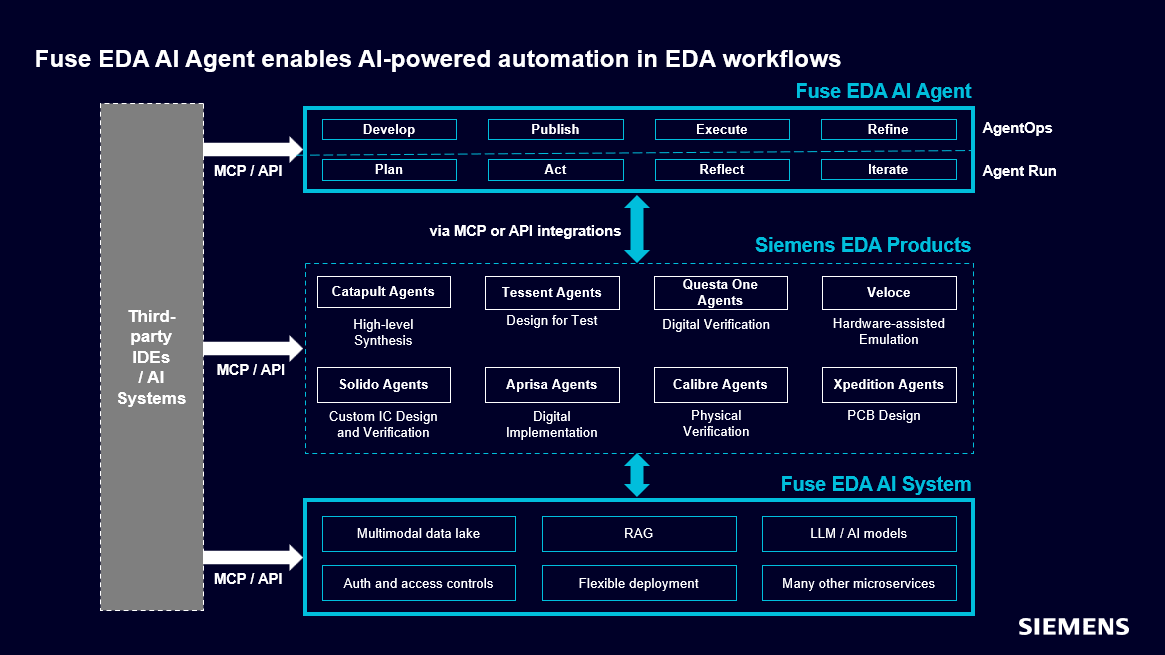
The Siemens Agent loop, put simply, is: Plan, Act, Reflect, Iterate, over “Develop, Publish, Execute, Refine.” “Self-verifying” in Siemens’ case means that agents “continuously validate decisions against deterministic, physics-based EDA engines.” According to SemiWiki’s Bernard Murphy, describing the Fuse launch, “the orchestrator can trigger repair agents, then re-run validation. This may resolve most errors,” although we were unable to get any comment on specific triggers.
Cadence’s description is that “every action the super agent takes is anchored” in its own proven design and verification engines, to ensure accurate results. These, like Siemens’ solution, can run “within a secure Nvidia OpenShell sandbox” to enforce guardrails and ensure predictability. This allows engineers to “inspect, guide and collaborate as needed” even at Level 5. The human engineer works from their own runtime environment, then “once the super agent finishes that loop … the auto-run environment can interpret, understand, and then fire off that next message, right, that next iteration,” Knoth said.
Synopsys also retains the human element, with the debug workflow’s output as root-cause analysis and resolution through engineers. The flow iteratively runs checks against generated, unit-level testbenches, with the agent handling design and the tests themselves. When a check fails in Synopsys’ Verification AgentEngineer, the logs are consulted, and errors are aggregated to paint a picture of the most likely cause, checked against simulation waveforms. When applying the fix, the agent must prove that the bug has actually been fixed and should be able to produce a bug-fix manifest. Beyond this, the quantity of checkpoints is determined by customers’ trust and desired flexibility, and over time, “they might relax and take away those checkpoints,” Thiruvengadam said. The internal process, such as the specifics on retry limits, the definition of unfixable, and states requiring escalation, remains murky.
Early access everywhere
(Image credit: Cadence)
All of the numbers and roadmaps in the world don’t replace actual value to the customer, or actual customers with a released product. Thus far, the agentic platforms have been in early access and evaluation. Engagements have been listed, and major customers exist, but none are confirmed with a generally available product. General availability hasn’t arrived yet, but it has been promised by the end of 2026 by Synopsys, with Cadence’s AuraStack, its PCB and advanced-packaging agent, also due this year. Usable products and workflows exist, but the efforts remain nascent, despite relatively rapid claimed gains over the last year or so.
Cadence ChipStack has been in early access since February. In June, this extended to the promise of Level 5 capabilities with early access for customers in the second half of 2026. Synopsys has debug and implementation workflows, announced in July, available for evaluation on Microsoft Discovery, if requested. Microsoft’s platform is designed to assist in the construction and management of agentic AI workflows related to scientific and engineering fields. Siemens has the Questa One Agentic Toolkit, announced in February, and the Fuse Agent as of March, with promises made in July surrounding self-verifying capabilities in forthcoming releases. Empyrean is also developing its own platform as of the time of writing.
The current stacks largely run on Nvidia’s Nemotron and its OpenShell sandbox. Nemotron is a reasoning model family. OpenShell is an open-source runtime that keeps the agent contained with kernel-level isolation, protecting customer IP and guarding against rogue actions. Nemotron and OpenShell are open, so nothing on record prevents Empyrean from using them, but without announcements, it appears to be the outside case. What each EDA vendor does with this technology and the flexibility it offers its customers are the defining differences.
Earlier this week, Nvidia announced its Open Agent Safety Platform, a combination of OpenShell and the Sentry reference design, an “out-of-band watchdog” that runs on BlueField-4 DPUs to “continuously monitor agent behavior” and can quarantine an agent in milliseconds. Cadence, Synopsys, and Siemens are named among the more than 100 organizations working with Nvidia on the platform. Cadence’s Knoth told Tom’s Hardware Premium that OpenShell “helps ensure the agents are well behaved … don’t go rogue and start accessing data they’re not supposed to,” as agents need to become productive and trusted. Thiruvengadam from Synopsys echoed these sentiments, with both companies aware of the dangers of rogue agent actions.
Cadence and Synopsys, at least, needed licenses as of May 2025 for EDA sales to China, but the requirement was rescinded as of July of that year. EDA is expected to be critical for the industrial software space “toward the high end of the global value chain” by 2030, according to ChinaTechNews. According to Liu, as reported by the SCMP, Empyrean is trending away from traditional software licenses to a token-consumption pricing model with agentic EDA.
Startups in this space include ChipAgents, Cognichip, Agentrys, Silimate, and Ricursive Intelligence, most funded since December 2025. The big three buy other companies, from startups such as ChipStack to simulation software maker Ansys, as advances put EDA in the spotlight toward the end of 2026. Even with platform-specific flexibility, Nvidia remains the common ground, with its open model family and sandbox being the standard across the big three.
Swipe to scroll horizontally
Agentic EDA tools by vendor
Vendor
Agent
Flow stage
Status
Runs on
Cadence
ChipStack
RTL design, verification, debug
Early access (Feb. 10, 2026); bounded Level 5 in one domain shown June 1, 2026; Level 5 early access due H2 2026
Nvidia Nemotron, OpenShell
Cadence
InnoStack
Synthesis, place-and-route, signoff
Announced (April 16, 2026)
Not stated
Cadence
ViraStack
Custom and analog design
Announced (April 16, 2026)
Not stated
Cadence
AgentStack
Orchestrates the other agents
Used internally by Cadence IP and silicon solutions teams (Cadence, Sept. 28, 2026); customer early access due H2 2026
Nvidia OpenShell
Synopsys
AgentEngineer spec-to-RTL
Spec, RTL, testbenches, verification
Unveiled (March 11, 2026)
Not stated
Synopsys
Debug and implementation workflows
Debug; implementation
Evaluation (July 27, 2026)
Microsoft Discovery, Azure
Synopsys
AgentEngineer portfolio (seven agents)
Verification, implementation, AMS, manufacturing, simulation and analysis
General availability planned end of 2026; 50+ engagements (Sept. 28, 2026)
Autopilot platform; Nvidia Nemotron and OpenShell, or customer-chosen models
As it stands in 2026, the agents exist, and there are real roadmaps and customer evaluations. The framework hinges on existing technology already worthy of trust. The overall trend is toward harness engineering and, as Knoth told us, the implementation of “an array of specialized engines” to fuel the workflow end to end. Improvements, although currently lacking the independent measurement and precision we would like to see, are real and accelerating, according to vendors and their customers. It will become increasingly important to have proper evaluation of the different agents as they approach Level 5, “L5,” or some equivalent marker that denotes autonomous action.
What we would like to see by the end of the year is some customers named to actually be using the highest level of agent. Specifically, these agents must live outside of a trial or early access mode. This enables oversight and comparison in what will become an incredibly important field. We also anticipate Siemens’ forthcoming releases, which may demonstrate the self-verifying loop. Cadence is worth a close watch to see whether a Level 5 early-access customer is named before the end of the year. The baseline, though, is at production: real customers, real workflows, real products, and a measured improvement.