

Metal AM: Revolutionizing 3D Printing Technology | VoxelMatters

Before you print, find out if it’s worth it
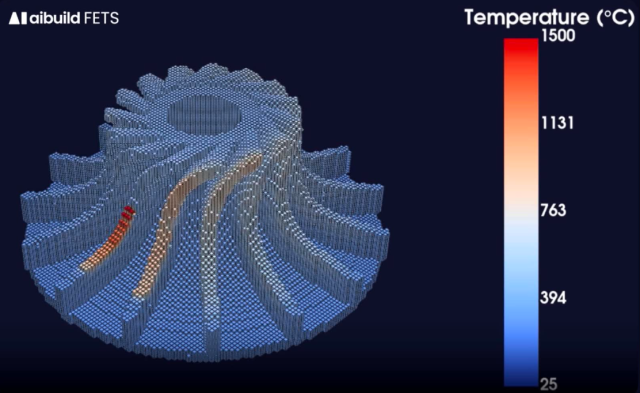
Aibuild, a software company serving the additive manufacturing industry, has just launched a tool called FETS. It is a thermomechanical finite element simulator that runs up to 10,000 times faster than any comparable solution currently available on the market. The tool has been validated by the National Institute for Aviation Research, NIAR, one of the most respected independent testing and validation bodies in the American aerospace industry.

Metal 3D printing, covering processes such as Wire Arc Additive Manufacturing, Directed Energy Deposition, and Friction Stir Additive Manufacturing, has been wrestling with one fundamental problem for years. Heat. More specifically, the fact that nobody knows exactly how heat travels through a part during printing and what it does to the material along the way. Parts warp, cracks appear, residual stresses destroy geometry. Every failed build means thousands of dollars lost on material, machine time, and energy that cannot be recovered. FETS addresses exactly that problem.
What FETS does and how it works
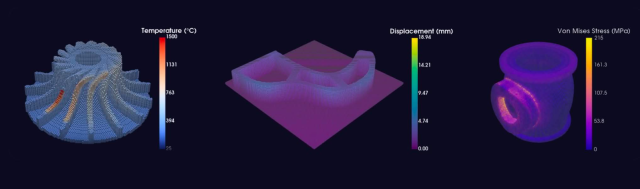
The tool allows engineers to run a full simulation of the printing process before a single layer of material is deposited. FETS covers six key output types: thermal distribution, thermomechanical simulation, distortion prediction, residual stress analysis, interlayer bonding quality assessment including weak adhesion and sagging detection, and crack prediction based on simulated stress. That is a complete picture of what will happen to a part during printing, available in minutes rather than days.
FETS runs on GPU compute via the cloud, eliminating the need for specialist on-premises hardware. Until now, a full FEA simulation required access to an HPC cluster costing upwards of $1.2 million. A standard computer with an internet connection is now enough. Equally important, the tool integrates directly into the CAM environment. There is no need to export files, manually rebuild layer geometry in a separate program, or bring in a simulation specialist. The finite element mesh is generated automatically from toolpath data. Engineers work where they always have, and the simulation runs in the background as part of the same digital thread.
Who is FETS for
Aibuild designed the tool to require no specialist FEA knowledge. The interface is straightforward, the number of parameters to configure is minimal, and the default settings are tuned to deliver reliable results without additional adjustment. In practice, this means that an ordinary AM machine operator can use FETS, not just an experienced simulation engineer. There is no need to manage separate software licences, convert file formats, or maintain a dedicated simulation environment.
Despite this accessibility, FETS is aimed primarily at industrial and aerospace manufacturers rather than small print shops or hobbyists. The economic case appears where the cost of a failed build is genuinely high: large metal parts, expensive materials, and long lead times. The tool is already available on the market, though the press materials do not specify pricing or subscription details.
NIAR validation results
NIAR tested FETS on two geometries, a thick wall and a thin wall, both made from 17-4PH stainless steel using a Wire Arc DED system built around Fronius and ABB equipment. For the thick wall, four build variants were tested: no thermal management, fixed 30-second interlayer waits, fixed 60-second interlayer waits, and FETS dynamic optimisation. The thin wall geometry was tested with dynamic optimisation only.
The results were clear. The thick wall simulation completed in 2 hours and 39 minutes, the thin wall in 54 minutes. Mean prediction error for interlayer temperature was 3.2%, with a maximum error of 6.37%. That is accuracy comparable to traditional FEA tools that require hours of manual setup and specialist hardware. FETS dynamic optimisation outperformed both fixed-wait variants across all tested cases.
Jeswin J. Chankaramangalam, Program Director at NIAR, noted that thermal control has been one of the biggest challenges holding back metal additive manufacturing at industrial scale. The FETS validation gives aerospace manufacturers a confirmed and accessible path forward for adopting the technology.
Aerospace applications
NIAR is working to qualify Wire Arc DED for specific aerospace applications where FETS will serve as the process control tool. The list includes six-meter wing ribs and spars with 70% buy-to-fly improvements, titanium pylon brackets and landing gear assemblies, and integrally stiffened bulkheads replacing traditional multi-part assemblies. On the sustainment side, the technology is expected to enable rapid production of replacement parts for systems no longer in production. Current aerospace forging lead times run from 12 to 18 months. Wire Arc DED with validated thermal control can bring that down to 2 to 4 weeks while reducing material waste by 70%.
What comes next
Aibuild is not stopping at FETS’s current capabilities. The company is working on integrating Fourier Neural Operator models from NVIDIA’s PhysicsNeMo platform, targeting a simulation time of just 5 minutes, which would represent a 99.9% reduction compared to traditional tools. Full real-time distortion and residual stress prediction is also on the roadmap, enabling geometry compensation before a build even begins.
Metal 3D printing has been promising an industrial revolution for years. For just as long, heat has been the wall it kept running into. FETS does not remove that wall. It just lets engineers walk through it before they ever reach it.