

Intel’s long-lost data center prototype ‘Arctic Sound’ Xe-HP multi-tile GPU surfaces in new engineering sample — Company’s cancelled AI processor features 32GB of HBM2E

Back in 2020, Intel first showed off its multi-tile data center GPU codenamed “Arctic Sound,” part of the Xe-HP (High Performance) family. It was supposed to represent one part of to be the company’s grand entry into the AI GPU market. Arctic Sound was ultimately limited to internal samples because it was cancelled as a commercial product. Today, one of those original engineering samples seems to have landed in the hands of Chips By Layers on X, who’s pictured it in all its glory.
Well that wasn’t what I ordered, I wanted PonteVecchio. Turns out some of the Arctic Sound HP tiled chips made it into engineering samples that got into the wild. Never thought I’d see one of these after they got memory holed. pic.twitter.com/31HdBSHWTgJune 14, 2026
Intel was working on a single-tile, dual-tile and a quad-tile variant of Arctic Sound; the picture above shows two tiles flanked by four memory modules on either side, which are 8GB HBM2E chips, so 32GB of VRAM in total. A single Xe-HP tile had 512 Execution Units (EUs) in its original config, but they were cut down for actual samples. This dual-tile part has 480 EUs per tile, or 960 EUs combined, which comes out to 7,860 shader cores. Arctic Sound 2T also had a 300W TGP.
We can clearly see “Intel Confidential” marked on the IHS, along with “QVS8 1.00 GHz.” Funnily enough, the OP actually ordered a Ponte Vecchio GPU but received this engineering sample instead. Ponte Vecchio is another fascinating product in Intel’s graphics history. It was part of the Xe-HPC (High Performance Computing) family and the true halo-tier AI GPU from the company, stitching together a 47-tile matrix featuring Xe cores instead of conventional Execution Units.

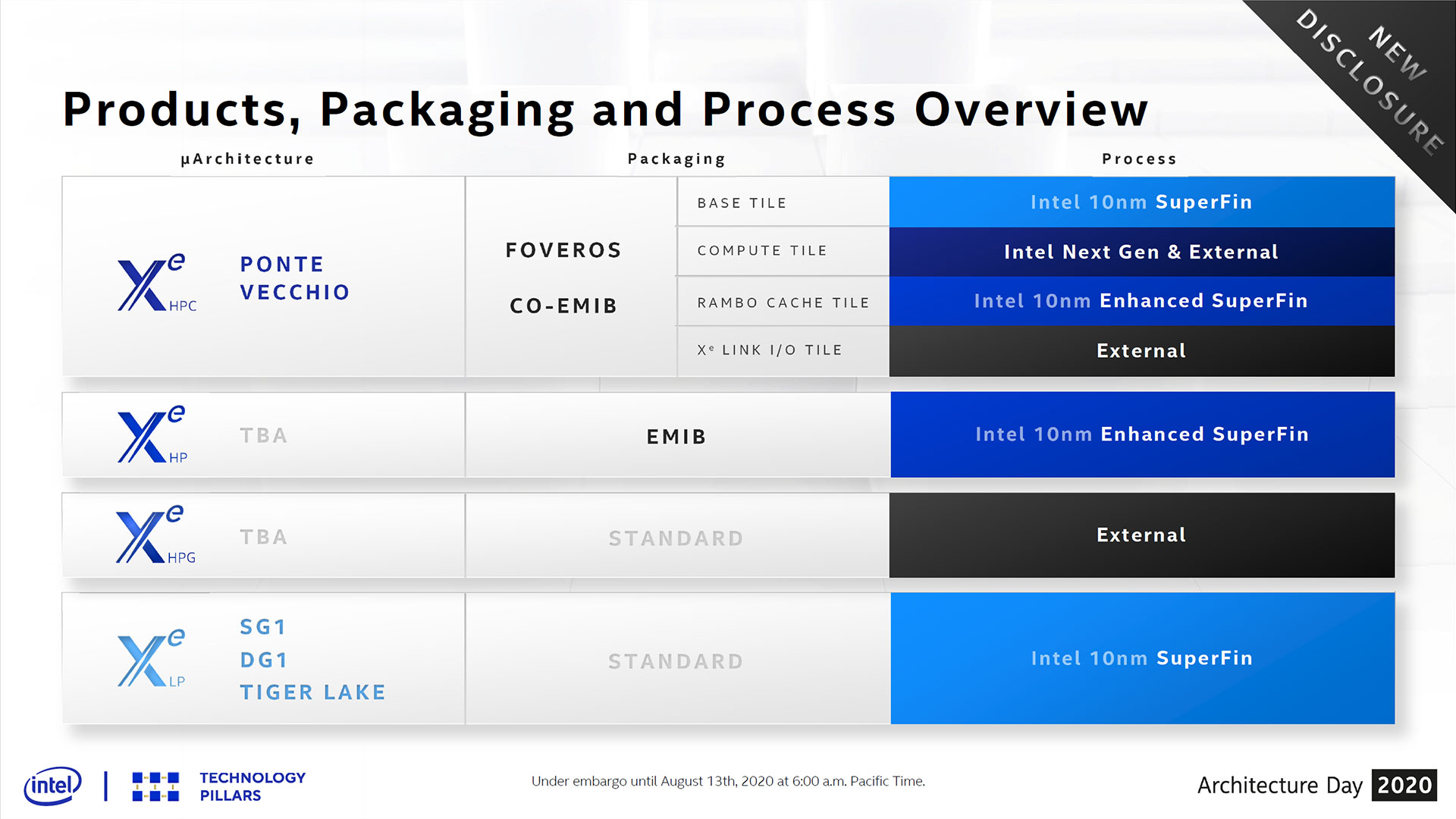
Arctic Sound basically proved it was possible for EMIB to horizontally connect multiple GPU tiles, so Intel used that along with its Foveros 3D packaging tech to build Ponte Vecchio. Eventually, Arctic Sound was cancelled as a commercial product because it was simply too expensive to produce. The company reworked it into “Arctic Sound-M,” which became the “Intel Data Center GPU Flex” series and it was moved to the Xe-HPG (High Performance Gaming) microarchitecture instead.
Next year, we expect to see Jaguar Shores, which can be looked at as a spiritual successor to both Ponte Vecchio and Arctic Sound since it scales the multi-tile concept to an unprecedented scale. Technically, though, it’s more in-line with Ponte Vecchio since it’s a flagship GPU, and that was already supposed to receive a direct successor in the form of Falcon Shores, but that lineup met the same fate as Arctic Sound last year.
The upcoming Cresent Island GPUs with LPRDR5X memory target a similar, cost-effective solution to data center compute that the original Arctic Sound tried to, so they’re probably the closest in terms of a proper sequel.

Follow Tom’s Hardware on Google News, or add us as a preferred source, to get our latest news, analysis, & reviews in your feeds.