
Hadassah doctors rebuild and lengthen leg using 3D printed implants | VoxelMatters

Doctors at Hadassah Ein Kerem in Jerusalem have reconstructed a patient’s hip joint and femur using two custom 3D printed implants, after a rare condition caused her bones to progressively disappear.
The patient, a woman in her mid-20s, had been diagnosed with Vanishing Bone Disease — an extremely rare condition in which bone is absorbed and lost for reasons not yet understood by medicine. Over several years, her femur head sank into the pelvis, her leg shortened by approximately 10 centimeters, and pain left her dependent on a wheelchair.
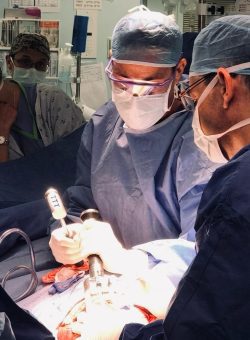
Dr. Omer Or, a specialist in orthopedic oncology and metabolic bone diseases at Hadassah Ein Kerem, led the treatment planning. Working alongside Dr. Gurion Rivkin, Director of the Joint Replacement Unit at Hadassah Mount Scopus, anesthesiologist Dr. Elena Patnik, and operating room nurse Esti Friedlander, the team designed and 3D printed two implants using advanced fabrication technology. The first reconstructed the missing pelvic bone and hip joint. The second was a custom lengthening implant built to replace the absent section of the femur and extend incrementally by up to 5 centimeters.
The treatment took place across two operations over approximately one year. During the first procedure, surgeons removed an earlier implant that had migrated into the pelvis as the surrounding bone had nearly fully disappeared, then placed both new implants, restoring the hip joint to its correct position and achieving an initial three-centimeter lengthening.
Following surgery, the patient used a home device powered by a low electrical current, applied three times daily to the implant site, to continue the gradual extension process.
“The original plan was to lengthen the leg by one millimeter per day for about 50 days — around five centimeters in total,” said Dr. Or. “Her body responded better than expected, and the leg was lengthened by another five centimeters after surgery, reaching a total of eight centimeters, followed by intensive rehabilitation.”
A second operation replaced the temporary lengthening implant with a permanent solid implant and added a further centimeter of length. By the end of the process, the patient’s leg had nearly returned to its original length.
“This case is exceptional not only because of the rarity of the disease, but also because of the solution that was found,” Dr. Or stated. “It combined reconstruction of missing bone in the pelvis and femur, a lengthening implant, and treatment of a disease in which the bone itself disappears.”