
Creality Falcon T1 Review: Modular laser engraving

Why you can trust Tom’s Hardware
Our expert reviewers spend hours testing and comparing products and services so you can choose the best for you. Find out more about how we test.
The Creality Falcon T1 is a galvanometer laser engraver that can swap between different laser modules for specific applications. With diode and fiber lasers for general engraving, a UV laser for creating 3D shapes in crystal, and a MOPA laser for adding color, the Falcon T1 is well-equipped on paper for most engraving tasks. The 175 x 175 mm engraving area and optional conveyor belt allow users to engrave small objects one at a time or in a large batch, and the optional rotary attachment can be used for tumblers, rings, and other cylindrical objects.
The Falcon T1 is at the higher end of Creality’s Falcon line of laser engravers, with the base model equipped with the 20W diode laser listed at $2,249 and the additional modules ranging between $989 and $3,059 each. As of the writing of this review, buying the Falcon T1 with the 20W diode laser module and adding all the additional modules would add up to $9,895 without any accessories such as the air filter, conveyor belt, or rotary attachment.
Creality shipped the Falcon T1 with three laser modules for testing: the 40W diode, the 20W fiber, and the 5W UV. The MOPA laser was not available and I wasn’t able to use it during testing. Creality indicated the UV module will have a retail launch in late July or early August, with the MOPA laser launching approximately one month after the UV module. This staggered rollout makes the Falcon T1 a risky day-one purchase if either the UV or MOPA module are critical to your workflow. The Falcon T1 has clear potential, but the overall experience I had during testing was that of a beta tester.

I ran into software issues, waited for parts to be delivered, and even had to schedule a 10 PM video call with Creality’s China-based support team due to the lack of US-based technical support. This level of support may be acceptable on a lower-cost hobby machine but it’s harder to overlook considering a fully loaded Falcon T1 can cost over five figures.
Specifications of Creality Falcon T1
|
Machine Footprint |
18.27 x 12.28 x 19.80 inches (464mm x 312mm x 503mm) |
Row 0 – Cell 2 | Row 0 – Cell 3 | Row 0 – Cell 4 | Row 0 – Cell 5 |
|
Engraving Size |
6.89 x 6.89 inches (175mm x 175mm) |
Row 1 – Cell 2 | Row 1 – Cell 3 | Row 1 – Cell 4 | Row 1 – Cell 5 |
|
Laser Type |
Diode |
Diode |
Fiber |
UV |
MOPA |
|
Laser Power |
20W |
40W |
20W |
5W |
60W |
|
Laser Spot Size |
0.12 mm x 0.14 mm |
0.14 mm x 0.18 mm |
0.05 mm |
0.014 mm |
0.05 mm |
|
Laser Wavelength |
445 nm +/- 15 nm |
445 nm +/- 15 nm |
1064 nm +/- 5 nm |
355 nm +/- 2 nm |
1064 nm +/- 5 nm |
|
Positioning Accuracy |
+/- 0.01 mm |
Row 6 – Cell 2 | Row 6 – Cell 3 | Row 6 – Cell 4 | Row 6 – Cell 5 |
|
Max Working Speed |
10000 mm/s |
Row 7 – Cell 2 | Row 7 – Cell 3 | Row 7 – Cell 4 | Row 7 – Cell 5 |
|
Enclosure |
Integrated |
Row 8 – Cell 2 | Row 8 – Cell 3 | Row 8 – Cell 4 | Row 8 – Cell 5 |
|
Cutting Platform |
Removable |
Row 9 – Cell 2 | Row 9 – Cell 3 | Row 9 – Cell 4 | Row 9 – Cell 5 |
|
Air Filter |
Optional |
Row 10 – Cell 2 | Row 10 – Cell 3 | Row 10 – Cell 4 | Row 10 – Cell 5 |
|
Connectivity |
USB-C, Wi-Fi |
Row 11 – Cell 2 | Row 11 – Cell 3 | Row 11 – Cell 4 | Row 11 – Cell 5 |
|
Release Date |
May 29, 2026 |
Row 12 – Cell 2 | Row 12 – Cell 3 | Row 12 – Cell 4 | Row 12 – Cell 5 |
|
MSRP |
$2,499 |
$2,999 |
$2,699 |
not yet available |
$4,999 |
Creality Falcon T1: Included in the box
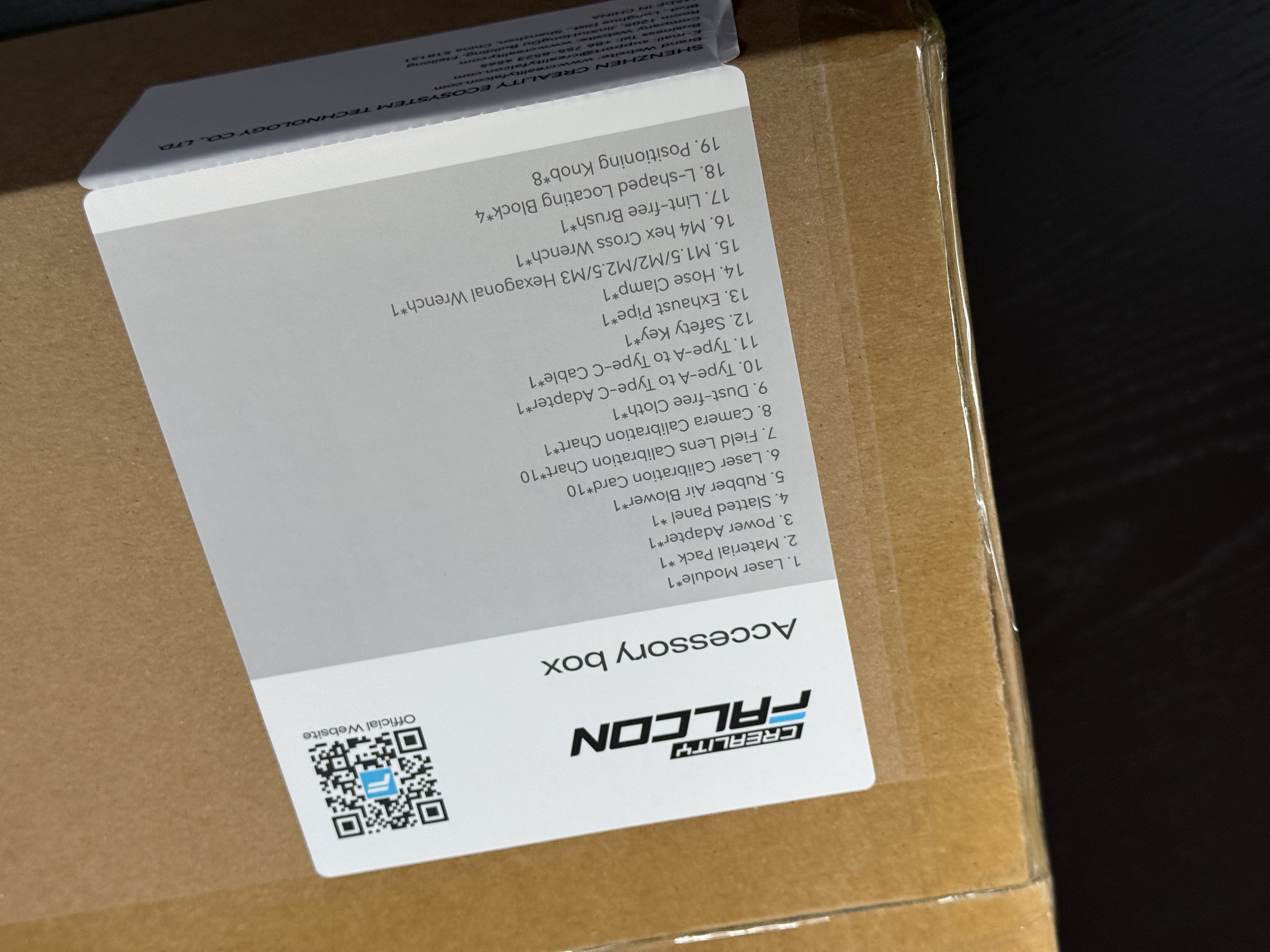
The Creality Falcon T1 includes more accessories than can fit in a single picture, including calibration boards, USB adapters, a brush, locking fixtures for the laser table, and much more. In addition to the included accessories, Creality also sent over the optional conveyor belt and rotary attachment kits, both application-specific extras that enhance the functionality of the machine.
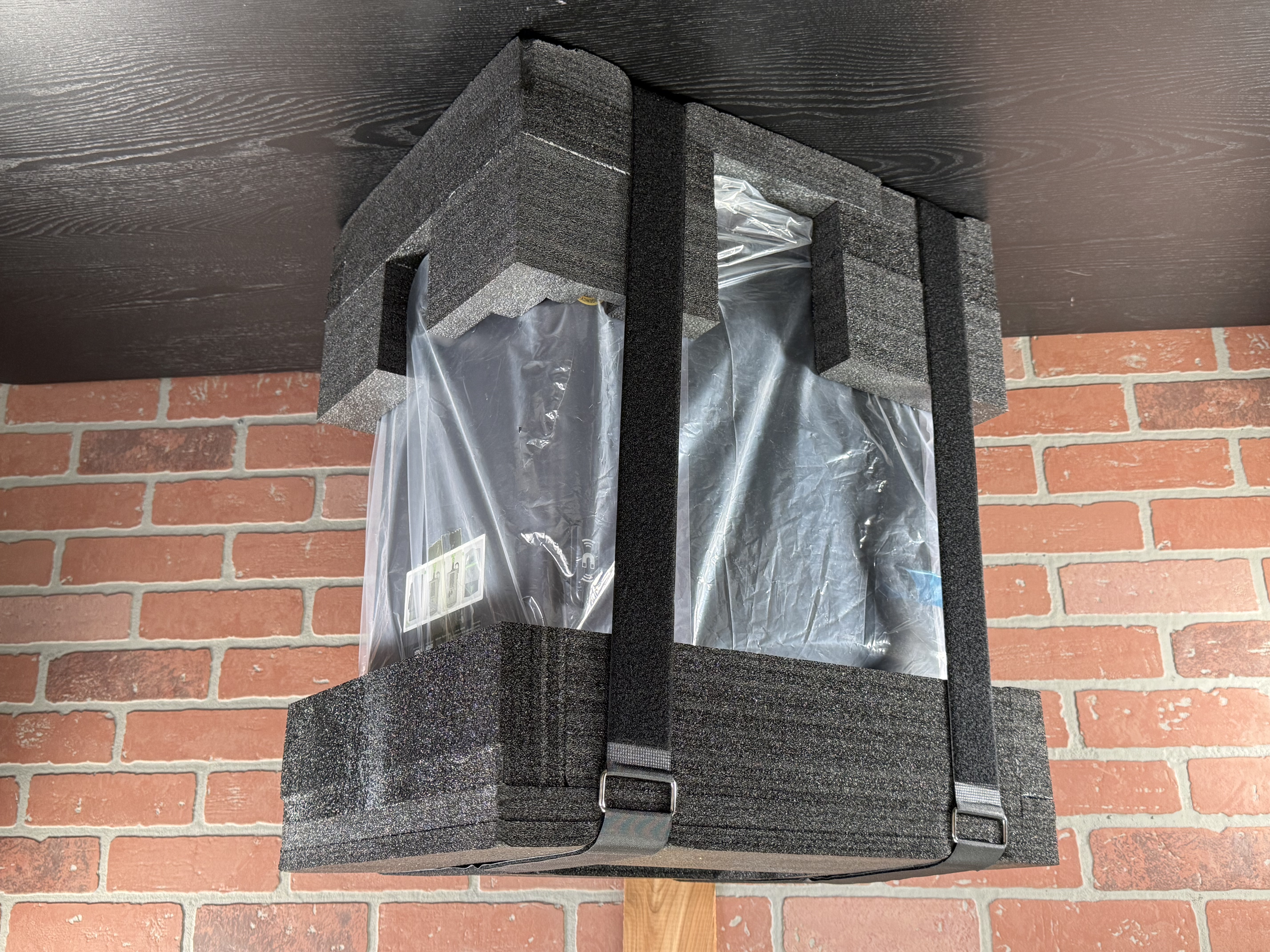
The packaging is what you would expect from a laser that retails at $2,249, with foam blocks and hook-and-loop straps securing the laser during shipping. Aside from sliding in the laser module (more on that later), there is virtually no assembly required other than plugging in the display and power supply. The Falcon T1 is ready to go right out of the box and doesn’t require advanced calibration or a lengthy setup.
Design of the Creality Falcon T1
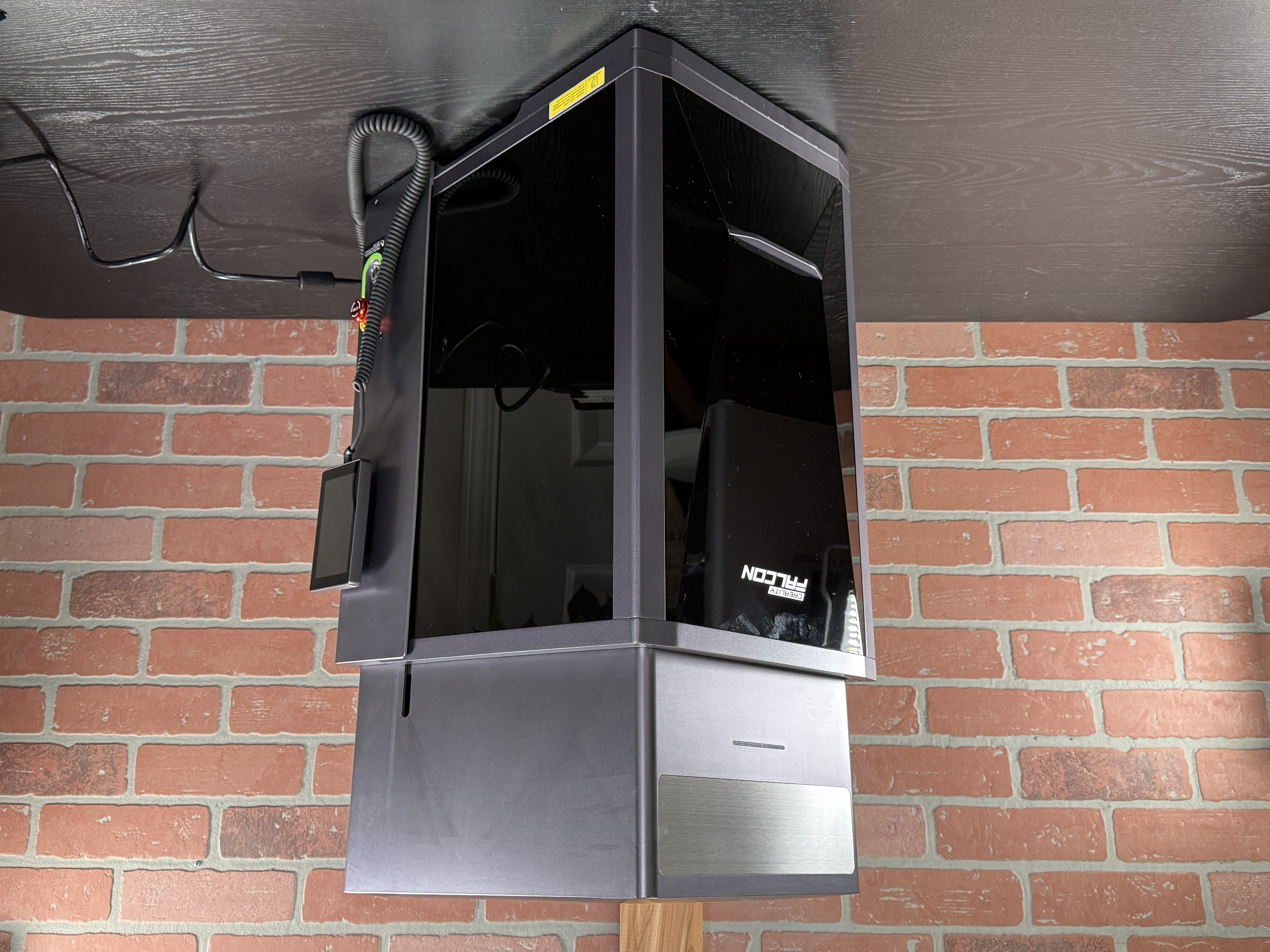
The Creality Falcon T1 is a more refined product that stands out in the otherwise generally hobbyist-focused line of Creality Falcon laser engravers. The translucent black cover looks like something you’d find on a piece of lab equipment, and the handle on the front makes it easy to lift without touching the glossy surface. The tall aspect ratio of the Falcon T1 is also a departure from the otherwise flat laser engravers you’d typically see from Creality, and the square 175 x 175 mm engraving area is also an indication that this isn’t a typical diode laser cutter.
Image 1 of 2
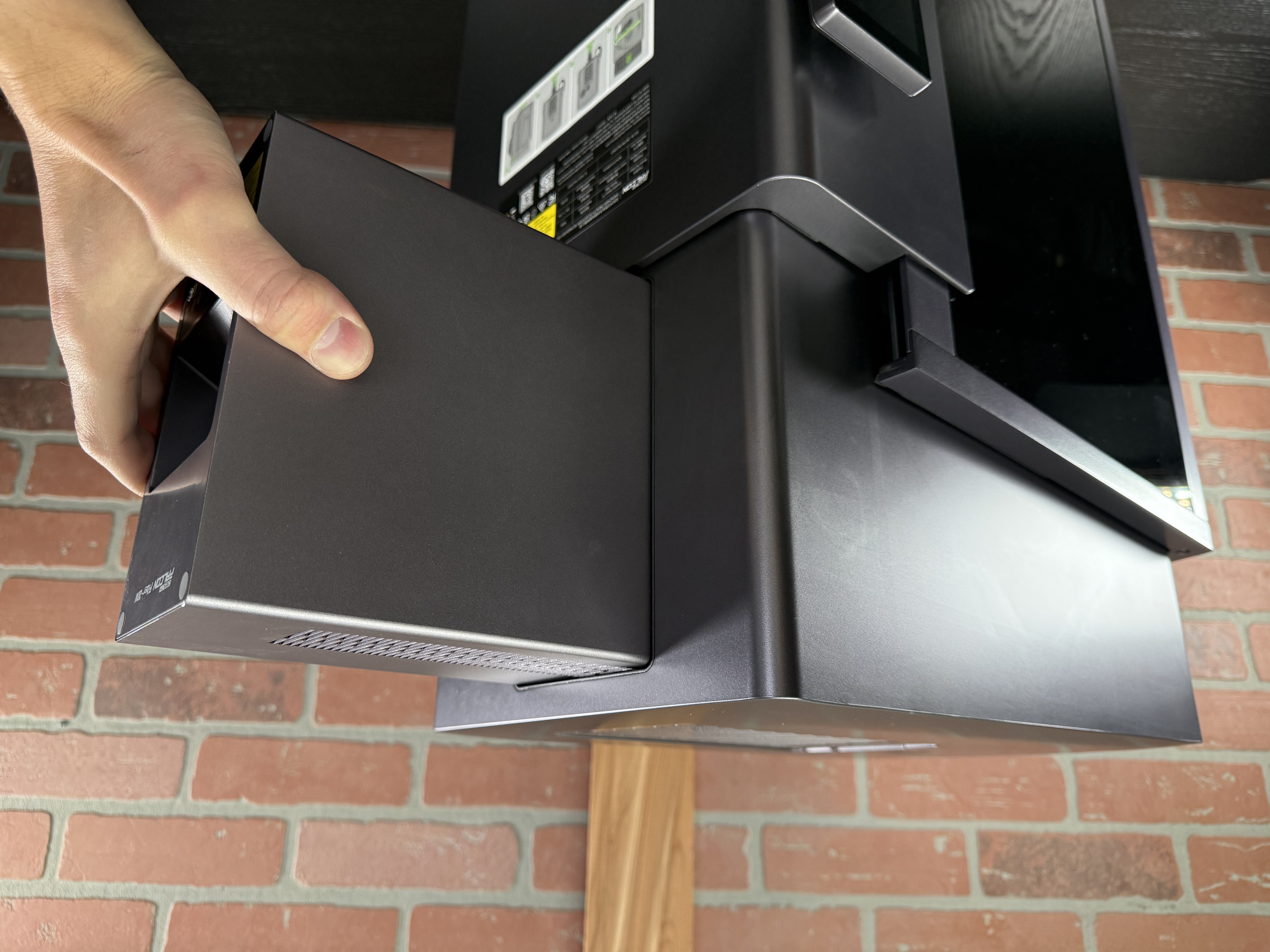
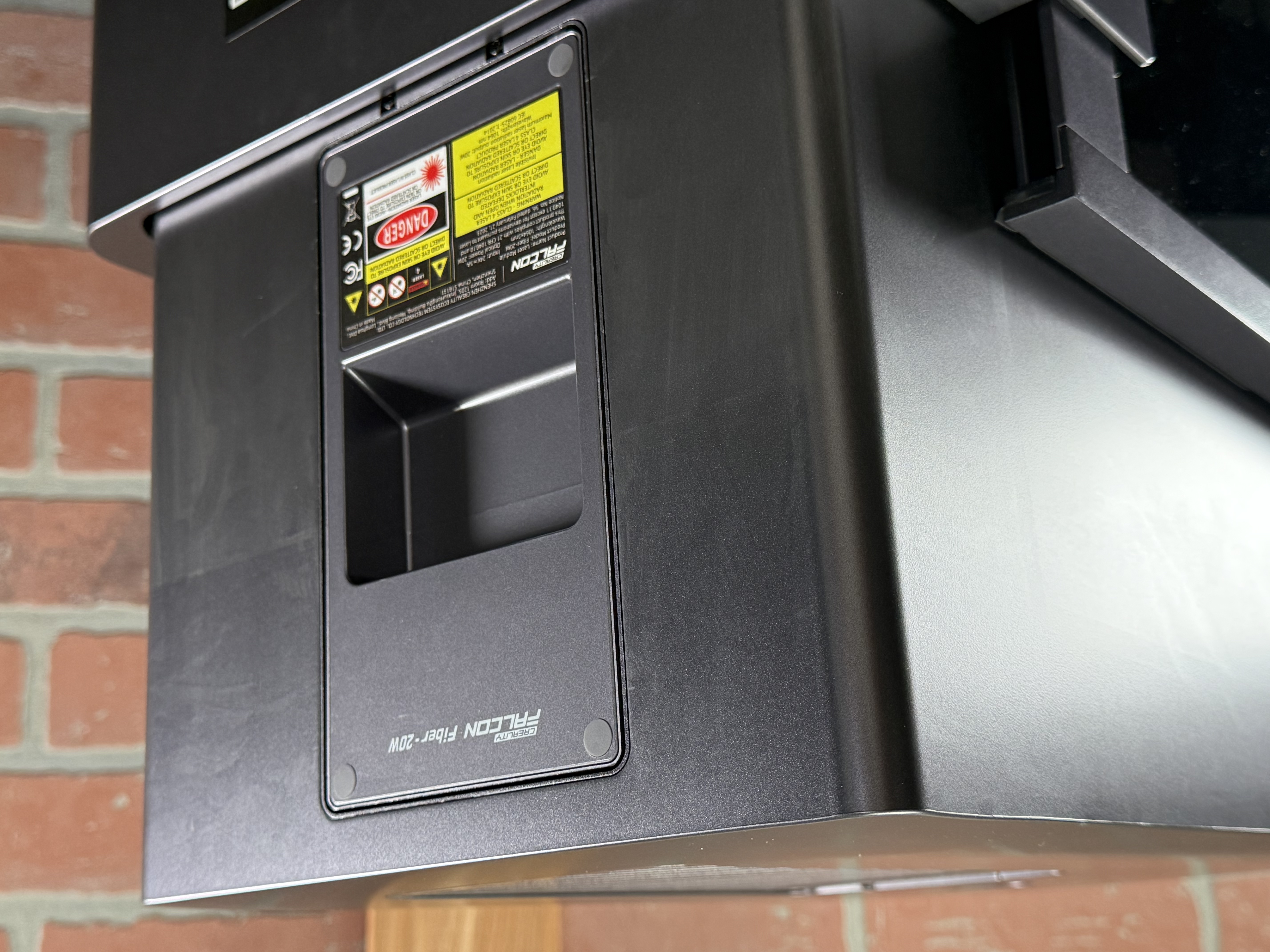
Creality heavily promotes the Falcon T1’s “5-in-1” functionality, which refers to the swappable modules that can be inserted and removed to change the type of laser. These include a 20W blue diode laser, a 40W blue diode laser, a 20W fiber laser, a 5W UV laser, and a 60W MOPA (Master Oscillator Power Amplifier) laser. These all have specific applications and are designed to be easily swapped by the end user.
Image 1 of 2
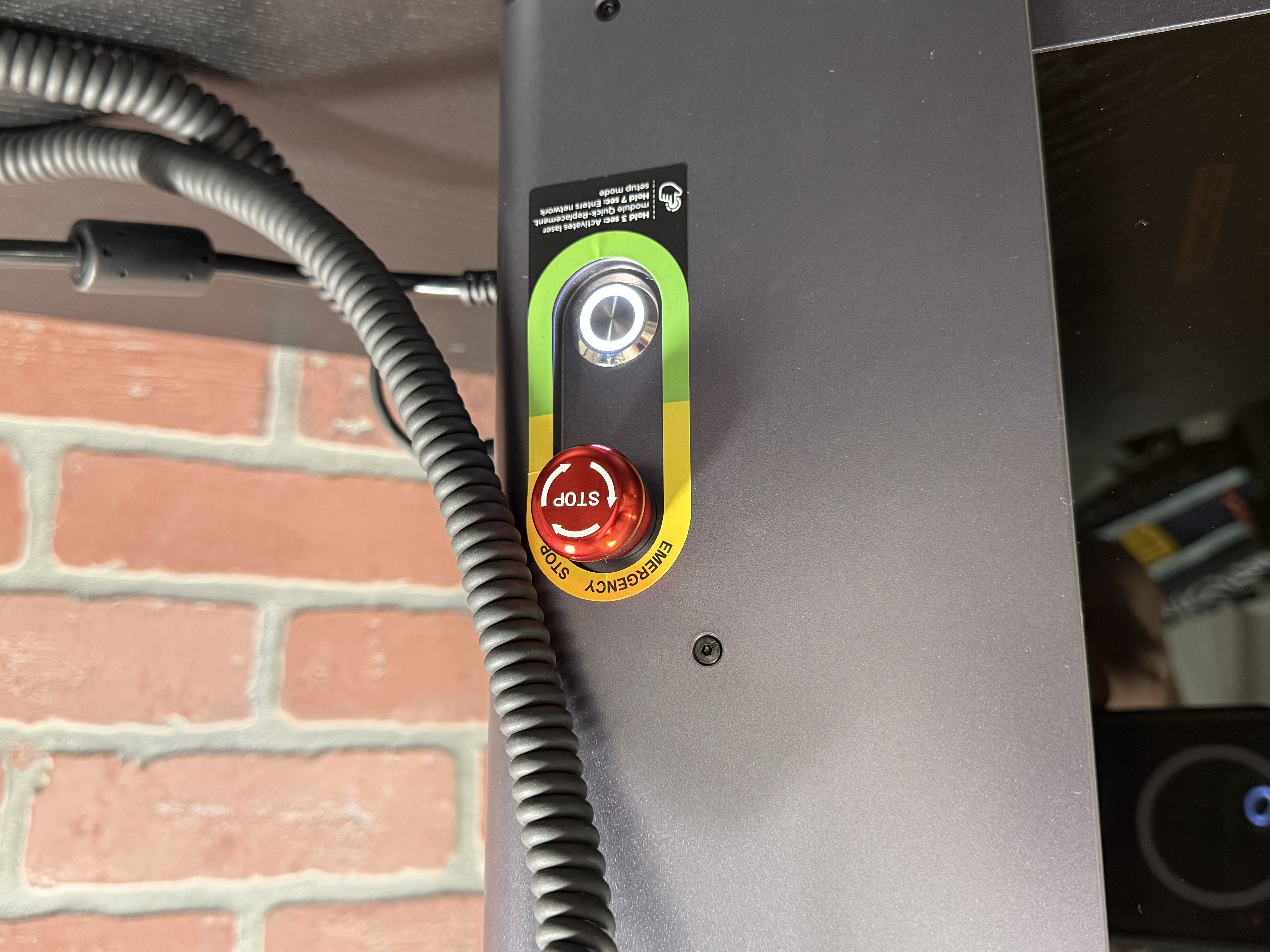
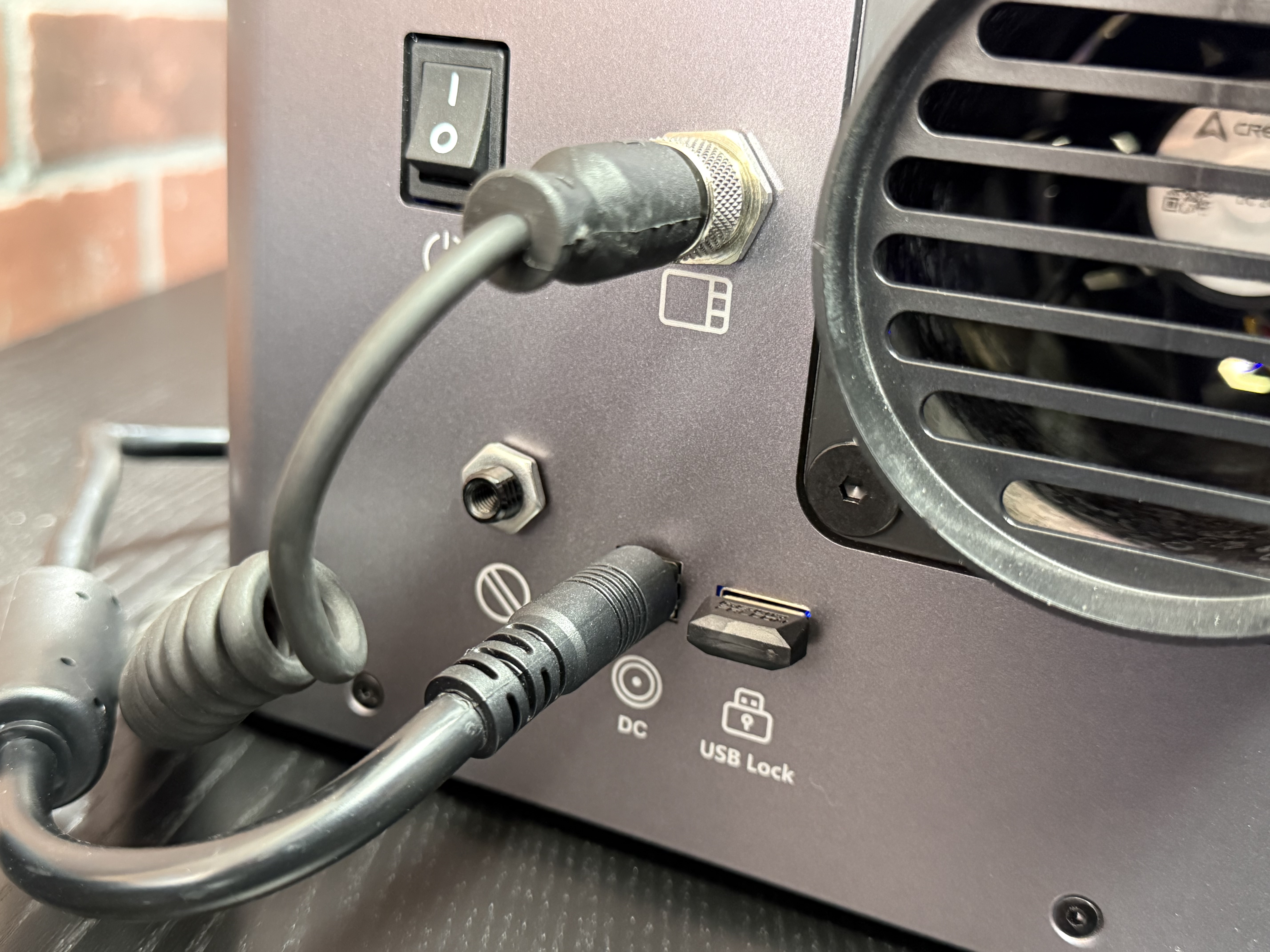
There is an emergency stop (E-stop) button on the side of the Falcon T1 as well as an arcade-style button which is used to fully extend the laser tower to replace modules. I tested the E-stop and found that it immediately cut power to the unit and required a manual reset to turn back on. Above the E-stop is the LCD screen, which offers basic controls, history, and network information. Additional ports for power, rotary and conveyor accessories, and the exhaust vent are all on the back of the unit.
Image 1 of 2
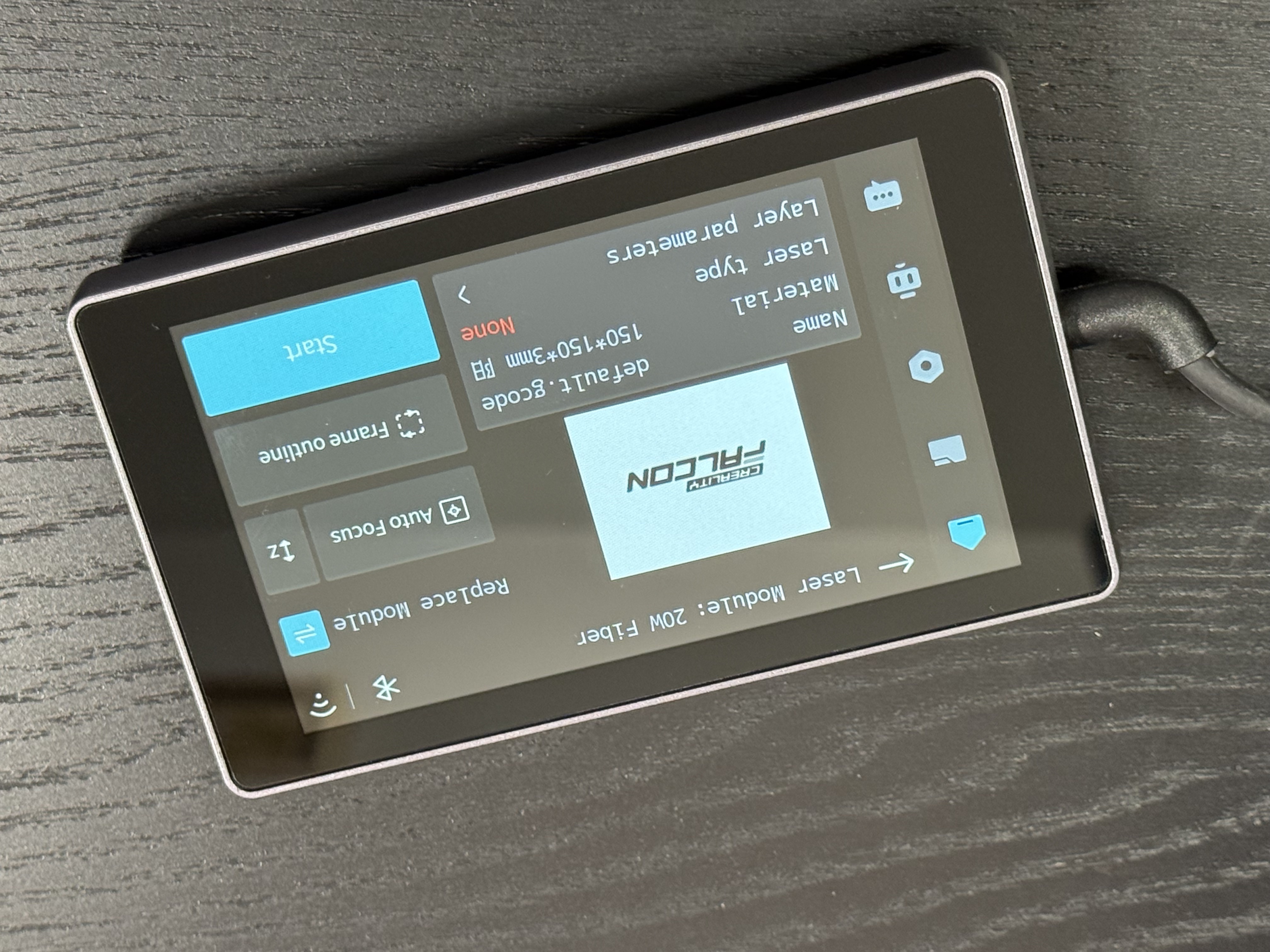
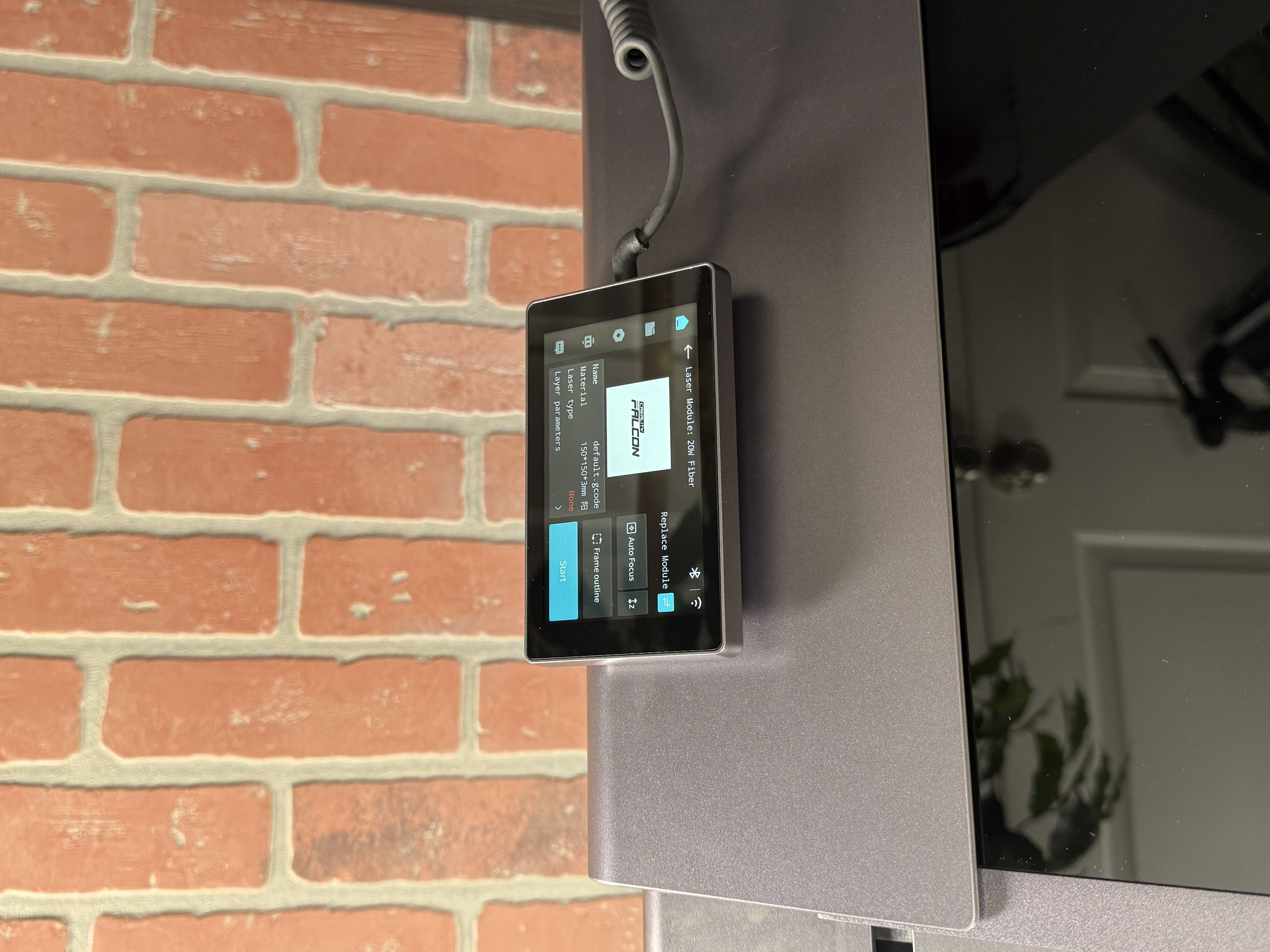
The design of the screen feels like an afterthought: the cable comes out from the left side of the unit which makes it awkward to hold with one hand and it’s sideways when mounted to the magnetic standoff on the engraver. Having the interface be vertical or putting the cord on the top of the unit would solve this, but with the current setup I found myself accidentally pressing buttons when I went to grab the LCD. After connecting to Wi-Fi, I used my laptop to start and monitor builds so the LCD didn’t see much use.
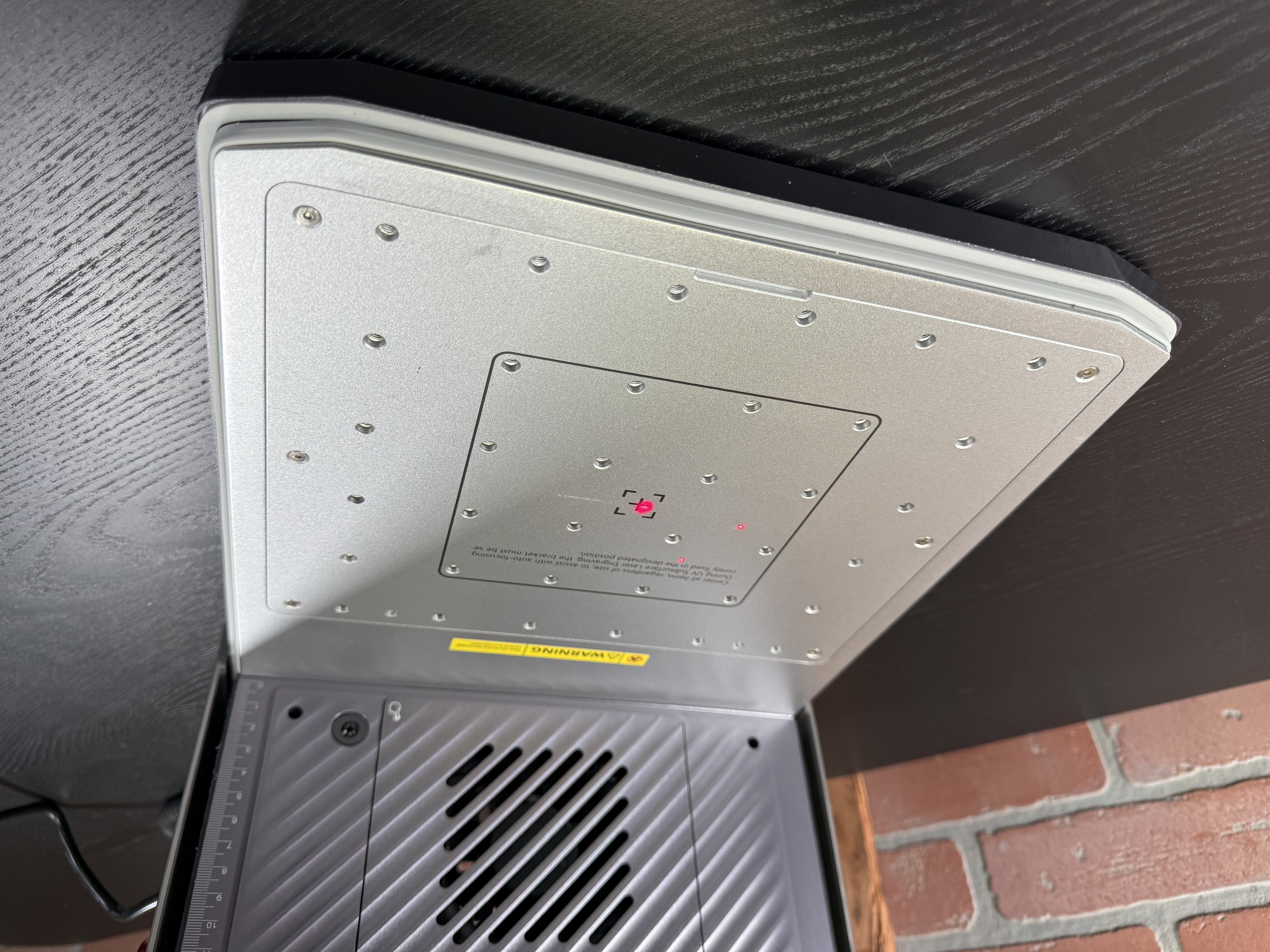
The Falcon T1 has an engraving area of 175 x 175 mm, which is in line with other galvo lasers like the WeCreat Lumos and the xTool F2 Ultra but smaller than most gantry-driven lasers. The engraving area has threaded inserts that allow workholding fixtures to be screwed in, something that’s critical when making very fine engravings where the object must be held still. The exhaust fan sits in the rear of the unit and did a good job during testing of pulling smoke and odor through the fan and into the air purifier unit.
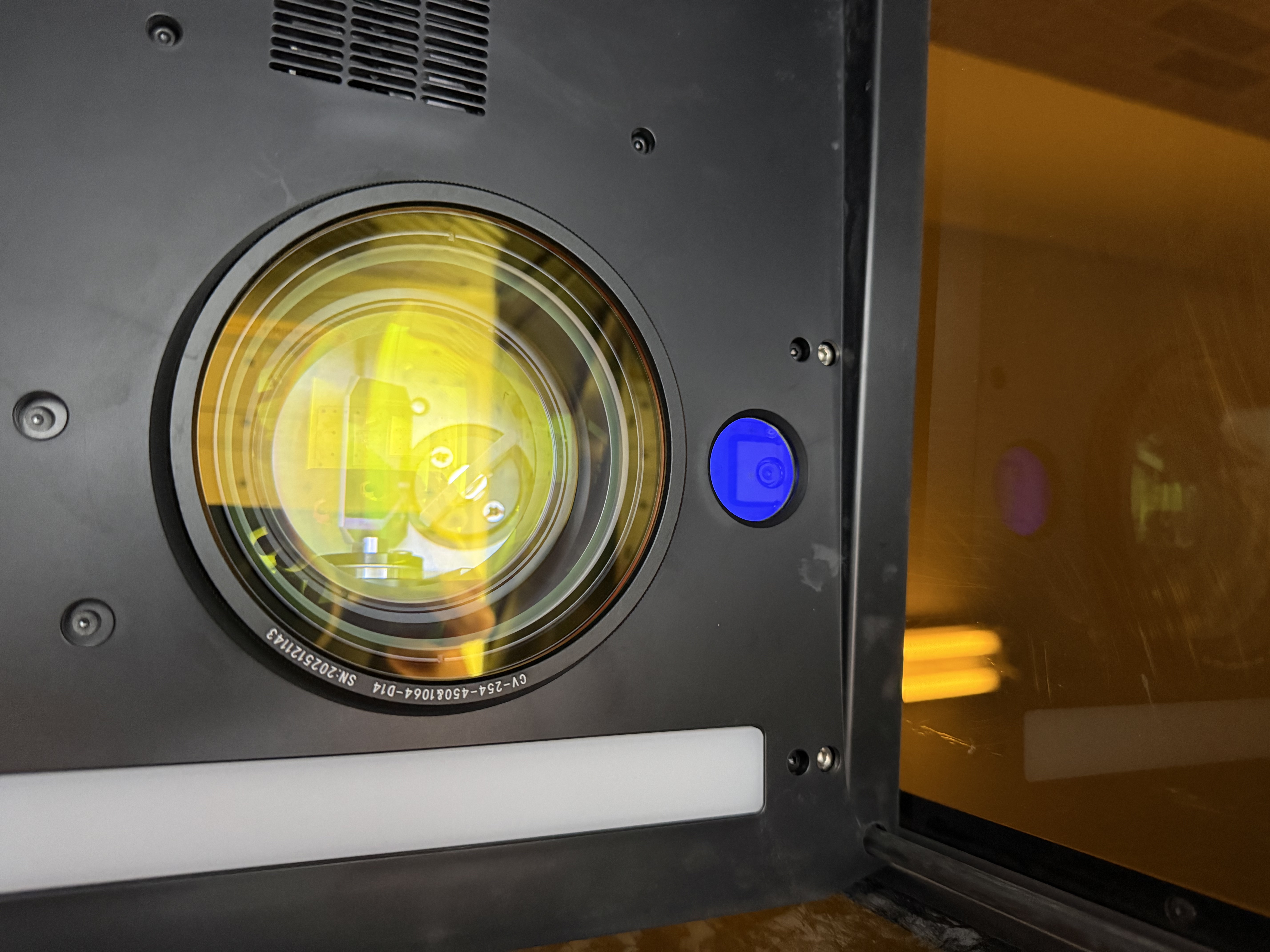
The Falcon T1 is capable of focusing the laser automatically with no manual calibration required, a useful addition that when combined with the integrated camera means setting up a build can be as simple as only a few clicks. The automatic calibration only takes a few seconds, and the workspace in the Falcon Design Space software will display material inside the machine to assist with laying out builds.
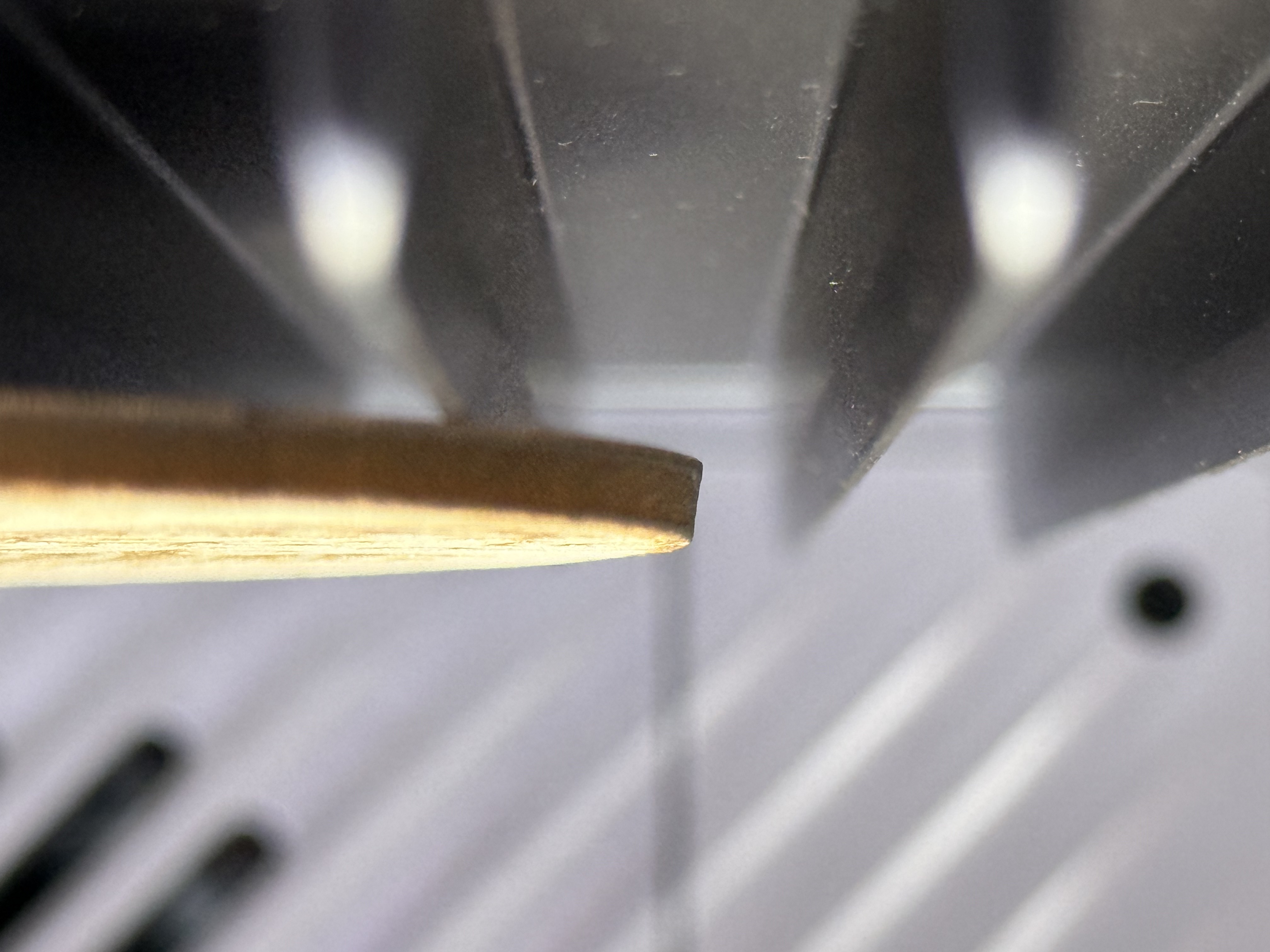
Unlike a gantry-driven laser like the WeCreat Vision Pro, the galvanometer system of the Falcon T1 means the laser beam always originates from the top center of the chamber, and as a result it creates angled cuts due to the conical shape of the laser work area. This means that cuts become progressively more angled as you move further away from the center of the chamber, something to consider if making an assembly or a design that has any interlocking parts.
Safety Features of the Creality Falcon T1
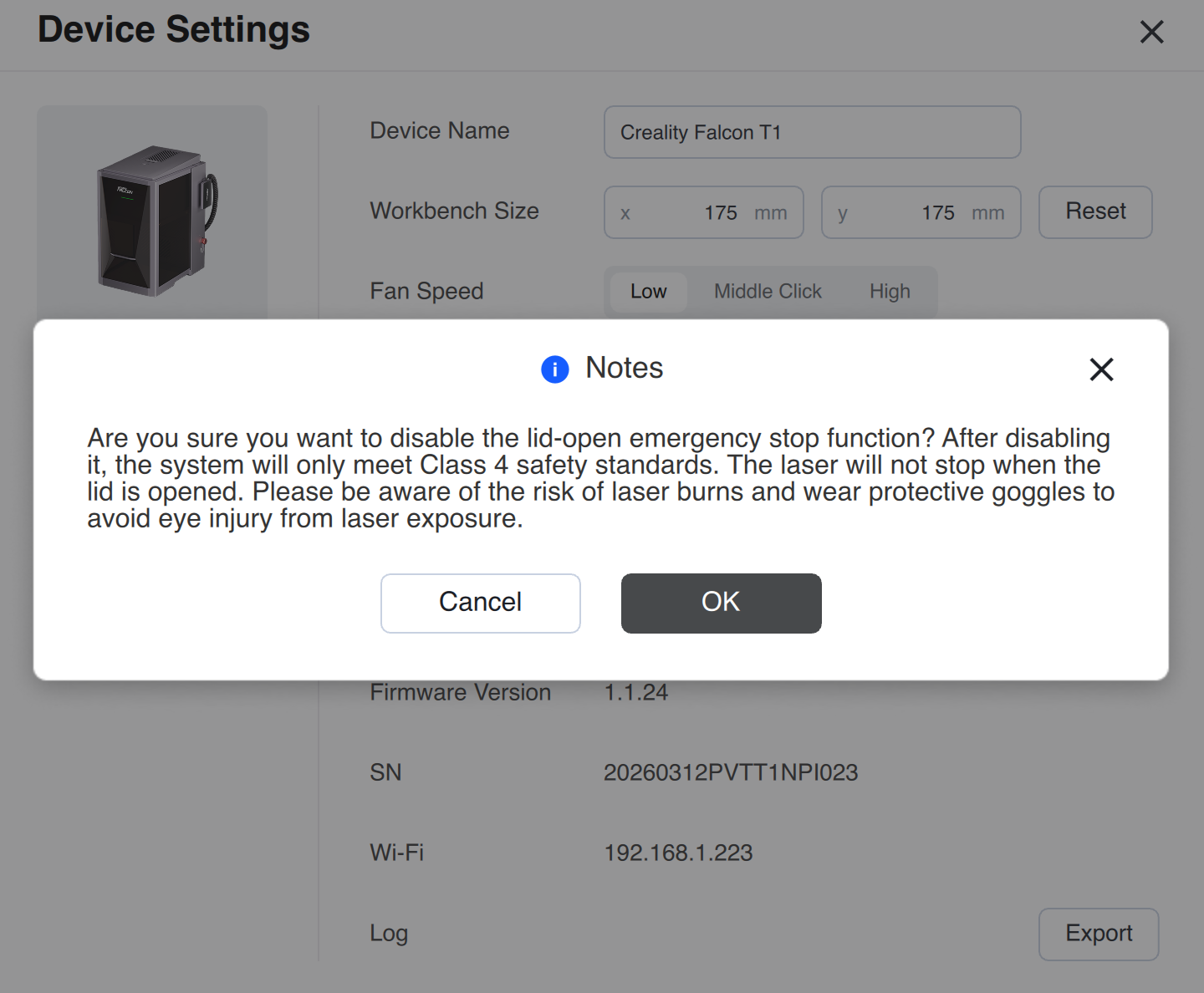
Like all lasers, the Creality Falcon T1 can be dangerous if misused or left unattended. Flammable material can ignite during cutting, and engraving produces dust and smoke that can quickly fill a room. When operated with the lid closed the Falcon T1 is a Class 1 laser, which means the user is shielded from the laser during operation. There is a large E-stop on the side of the Falcon T1 which will immediately deactivate the unit when pressed, an important addition for any high-powered laser.
Opening the lid during operation will throw an error, and the interlock will immediately stop the laser and display a warning in the Falcon Design Space. Using the conveyor belt or rotary engraver requires disabling the lid interlock, something that users should take very seriously. The risks of using an unshielded laser are much higher than when the lid is closed, so goggles and ventilation should be used when the lid is opened.
Smoke Purifier for the Creality Falcon T1
Image 1 of 2
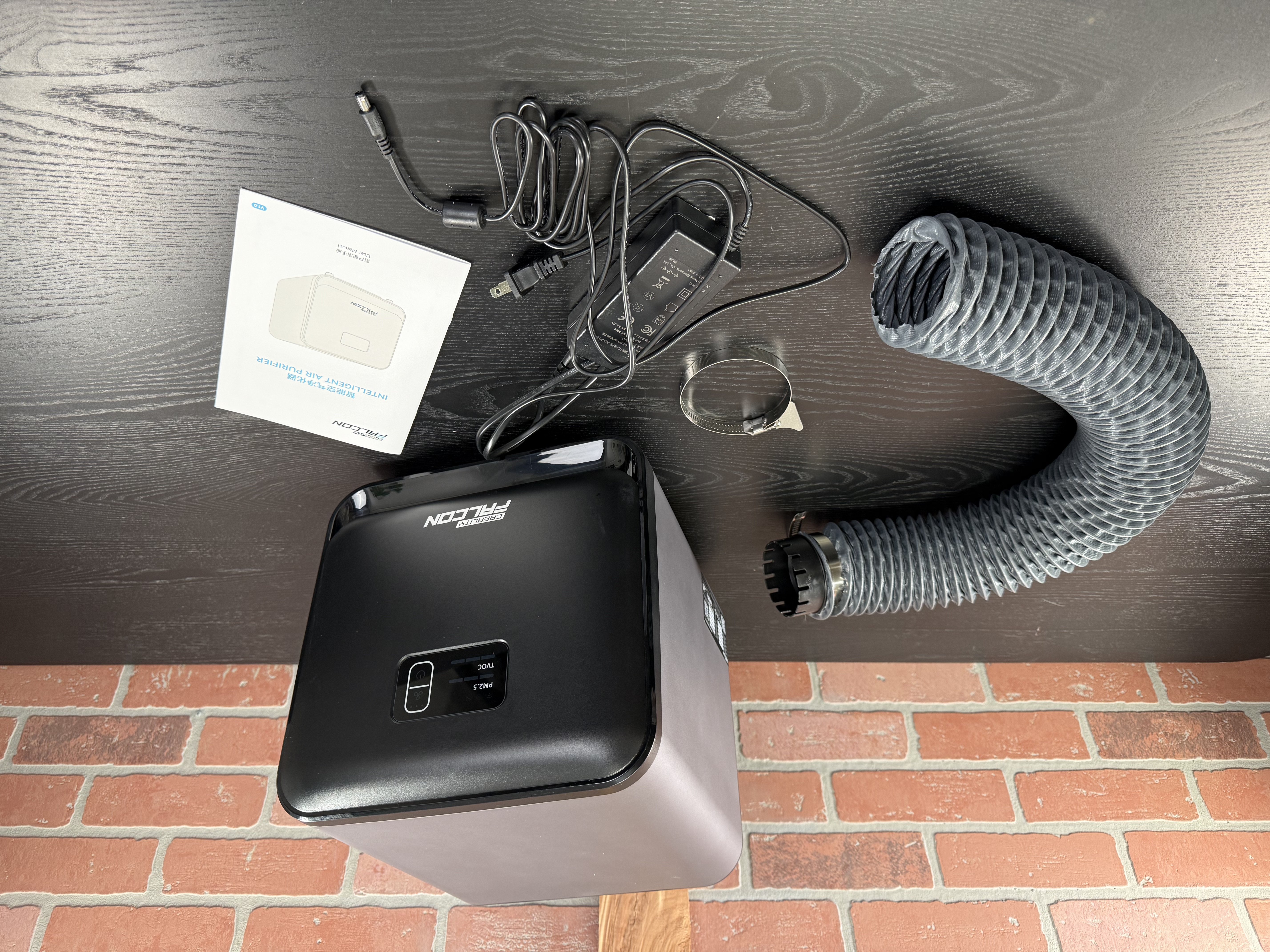
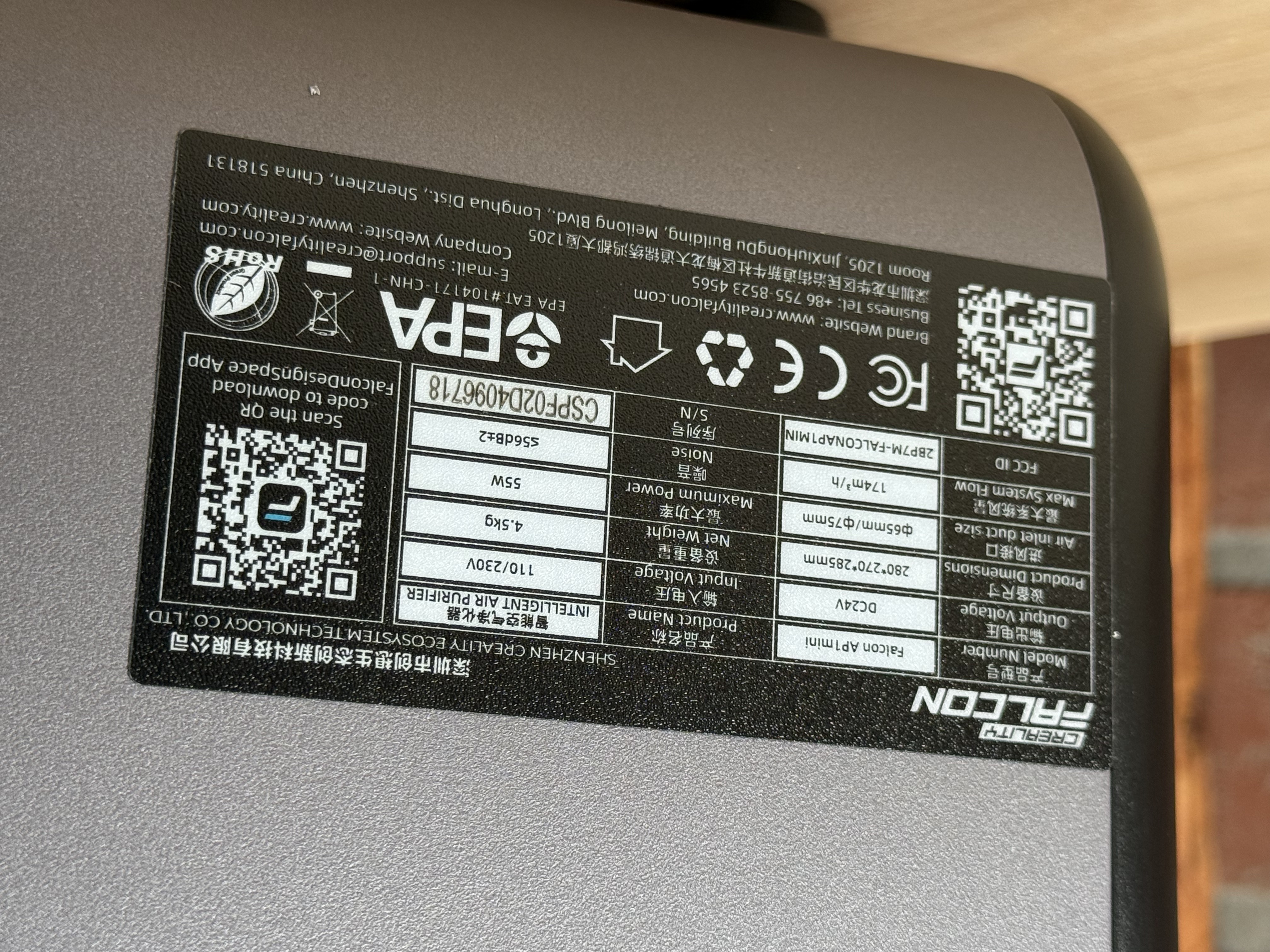
The Creality Falcon AP1 Mini is a small desktop air purifier that is a good match for the Creality Falcon T1, and the 174 m³/h airflow is more than enough to pull smoke and dust from the unit during operation. Other air purifiers like the WeCreat Fume Extractor offer much higher airflow volume for laser cutters like the WeCreat Vista and WeCreat Vision, which are designed to cut through thick sheets of material and generate lots of smoke.

The Falcon AP1 Mini is a good match for the Falcon T1, and I didn’t notice any smoke leaking from the enclosure during engraving jobs. If you’re planning on using the Falcon T1 primarily for engraving on metal, wood, and doing some 3D engraving, the AP1 Mini will be a great fit. If you are more interested in using the Falcon T1 for cutting through plywood, acrylic, or other material, you may want to consider a unit that provides more airflow.
Software for Creality Falcon T1

Creality offers the first-party Falcon Design Space software for the Falcon T1 as well as advertising compatibility with LightBurn, another popular laser engraver software. Falcon Design Space offers control over the laser speed and power while also giving users editing tools for vector graphics. I’ve had good experiences with Falcon Design Space in the past and the current version of the software (v1.9.3) keeps all the good stuff while also adding in a new set of generative AI-enabled tools.
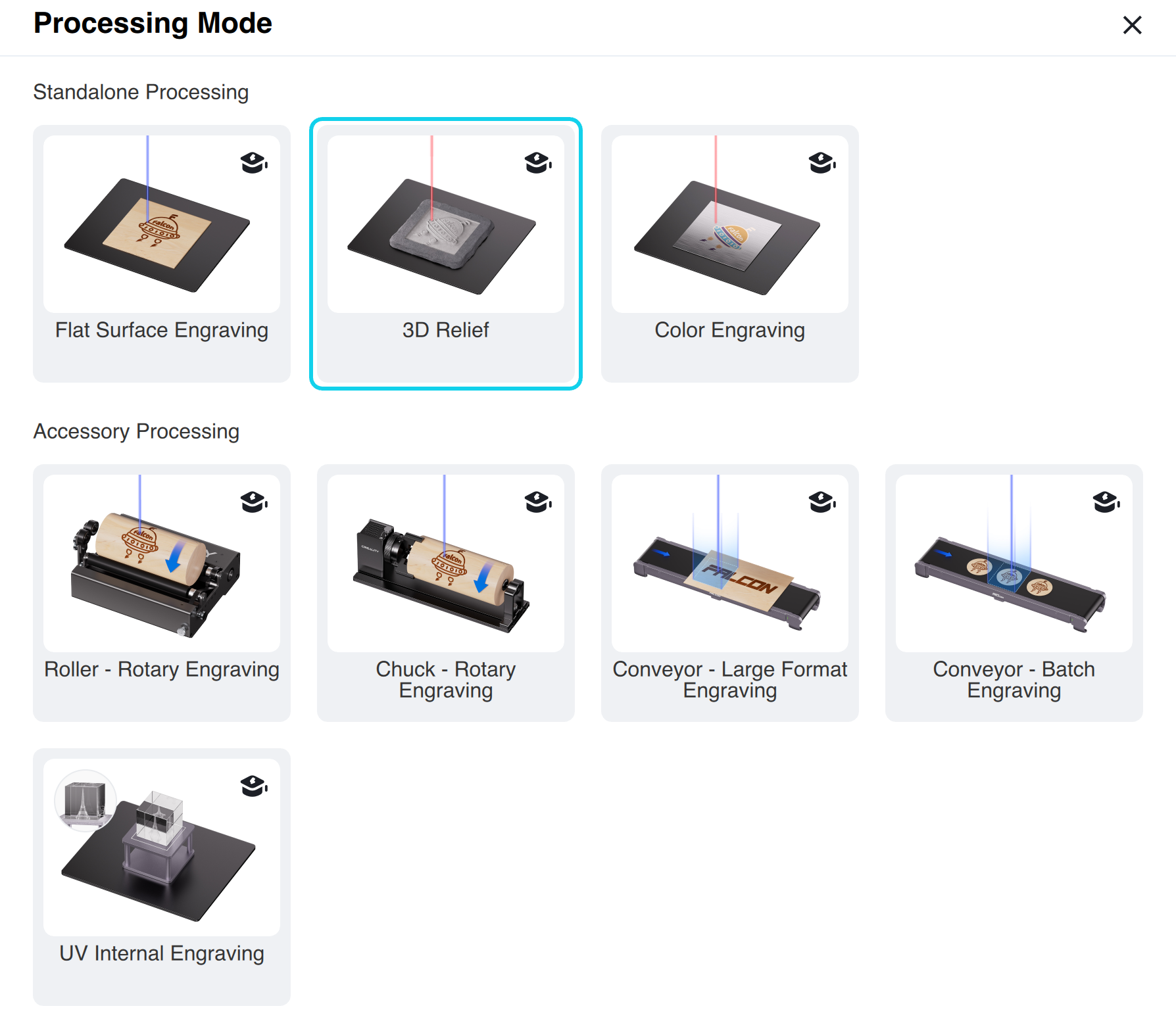
Between the modular laser attachments and the additional accessories, the Falcon T1 offers a total of eight different modes for processing a build. Without any accessories attached, the standard three modes are flat surface engraving (a typical laser engraver experience), 3D relief (designed for deeper cuts on material), and color engraving for the MOPA laser. Each mode offers a slightly different experience in the software, and the included video tutorials are well-made and easy to follow.

The software includes a mix of functional tools and creative ones, with the ability to generate 3D depth maps, pictures from generative AI prompts and filters, and general editing tools. Like with many generative AI tools, the output from these tools can vary wildly from surprisingly good to shockingly bad, and the overall experience will heavily depend on the user, inputs, and level of post-processing. I was impressed with the “3D Cutting” tool, which is similar to the Autodesk Slicer software that converts a 3D model into a series of parts for assembly, like a Benchy made of plywood.

Falcon Design Space also allows users to search through a repository of models and import them directly into the canvas, making it easy to find templates or starter projects for beginners. This is a fun way for new users to see what’s possible with a laser engraver, and the ability to modify or customize them lowers the barrier to entry.
Image 1 of 2
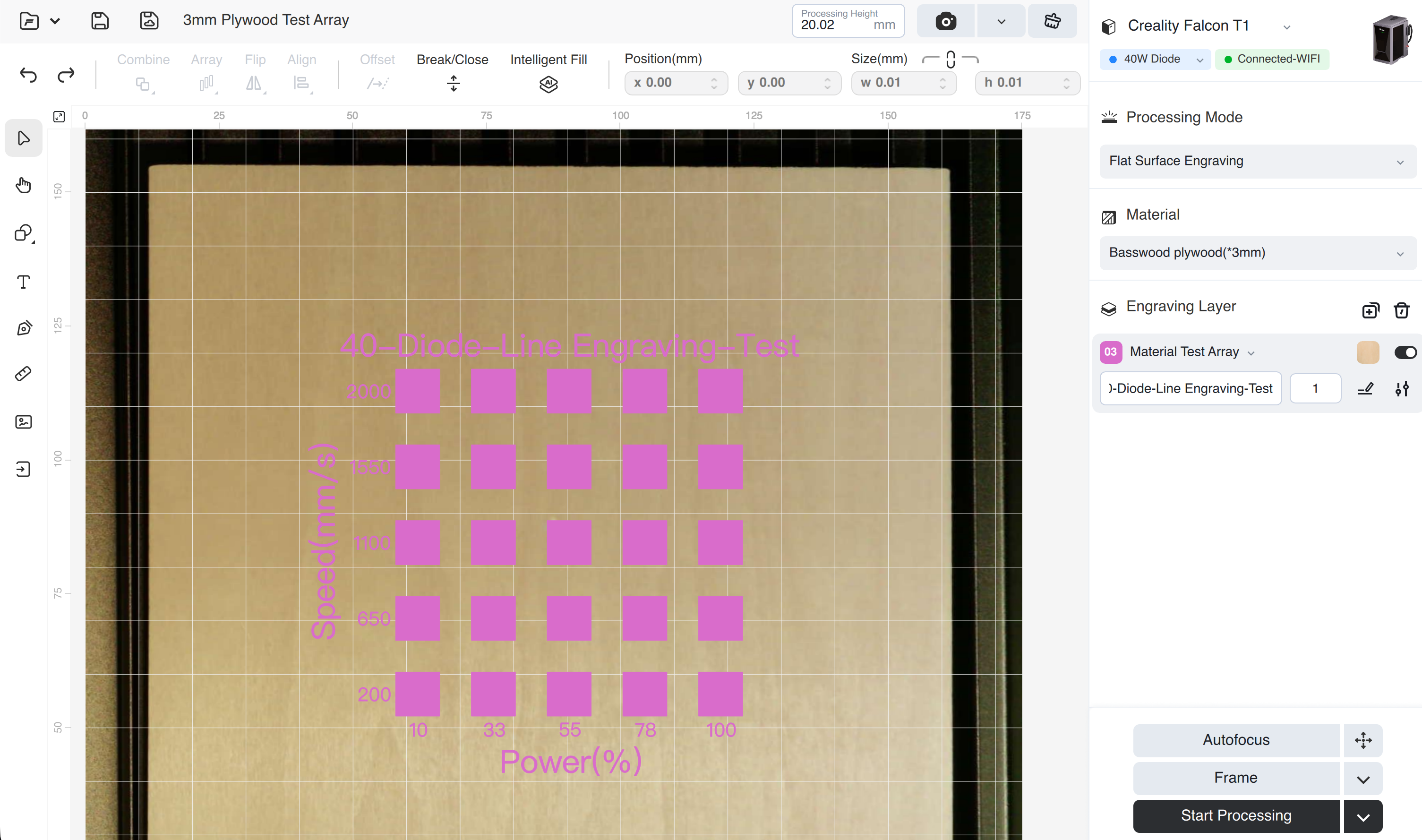

One of my favorite functional tools in Falcon Design Space is the Material Test Array, which allows users to quickly create a matrix that shows the impact of adjusting the speed and power of a laser and how they influence the quality and properties of the engraved material. Using the 40W diode laser and the recommended settings, I engraved a sheet of basswood plywood and was able to easily see the impact of adjusting the parameters as well as selecting a configuration that worked for me.
Engraving / Cutting with the Creality Falcon T1
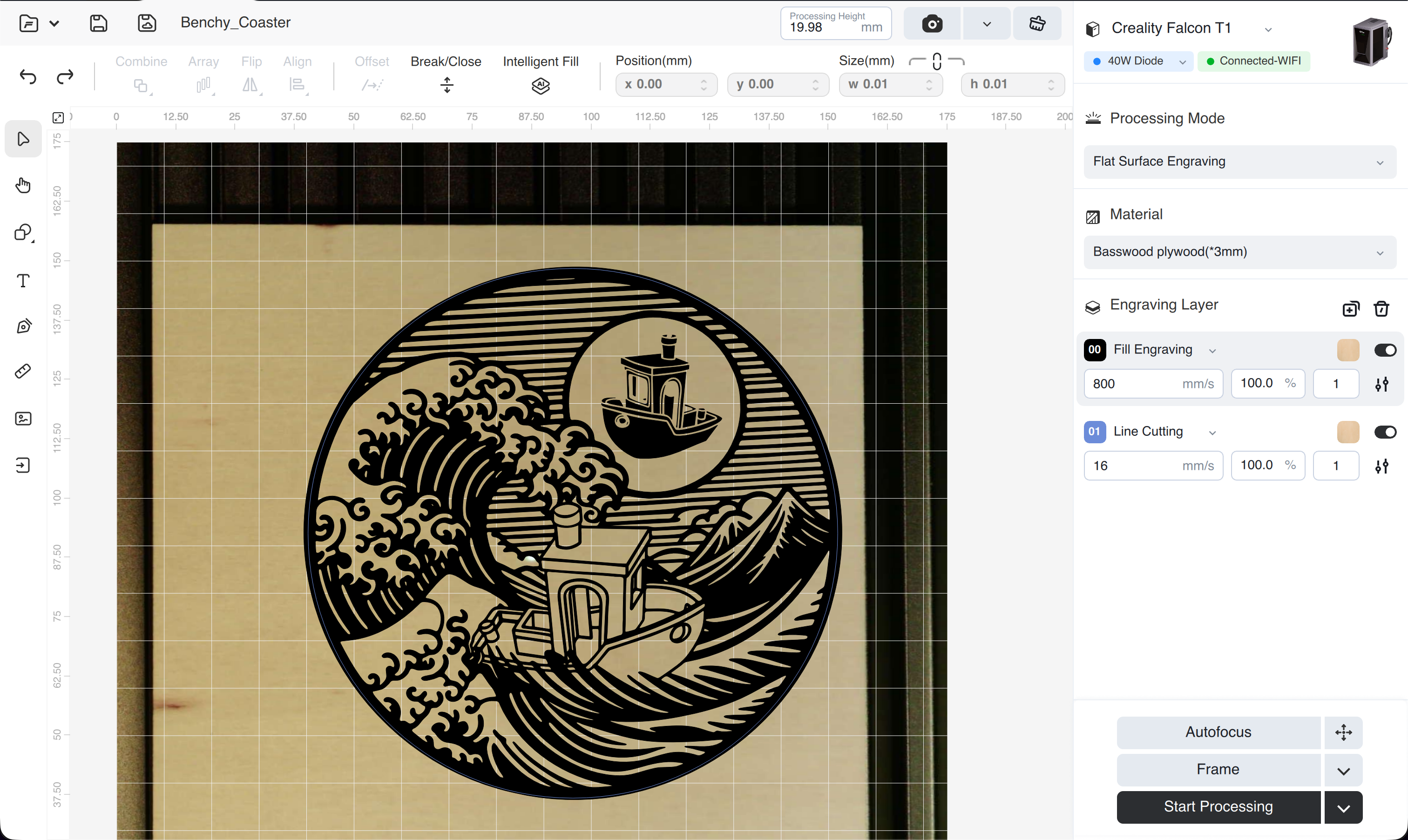
The 40W diode laser module was the most approachable for me to use as an initial test, so I loaded it in and set up a simple engraving / cutting job. Using the Benchy T-Shirt design by InfernoMoon, I used the 40W diode laser to engrave the design on some 3mm basswood plywood and also cut it out of the sheet. Adding layers in Falcon Design Space is simple and intuitive, so it was easy to set up the job so the engraving would be done before cutting the part out of the material.
At 800 mm/s, the coaster build was completed in just 1 minute and 44 seconds. Seeing the rapid movement of the galvo laser on the engraving is impressive, and compared to gantry-based lasers like Creality Falcon A1 Pro it’s no contest when it comes to speed. Based on the results of my initial material test array, I wound up making two versions: one at 800 mm/s and one at 650 mm/s, both of which looked good to me.
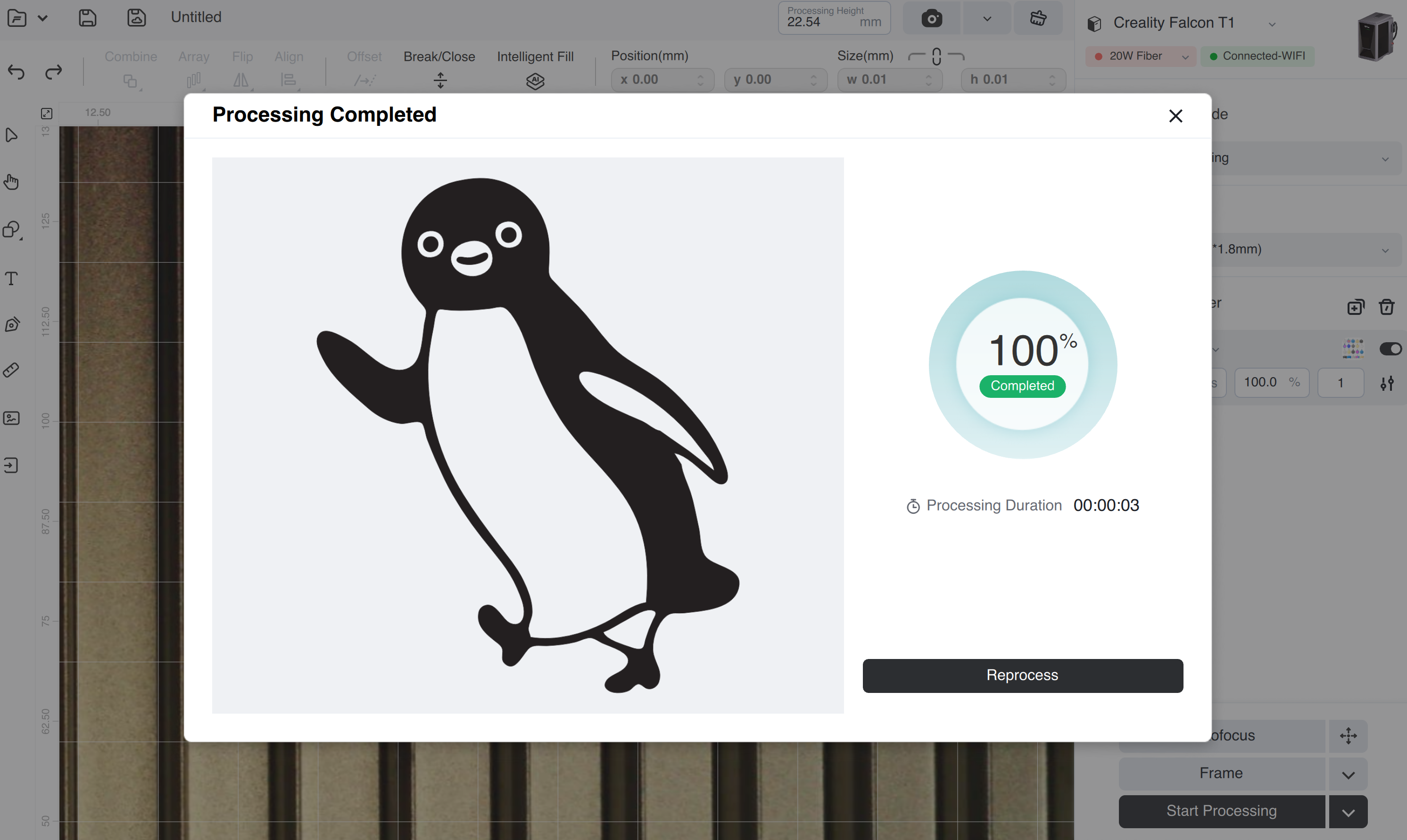
Switching to the 20W fiber laser, I engraved the JR-East Suica penguin logo on a dog tag to put on my luggage, and this was the moment that the galvo laser clicked for me. The software went from “Sending Job” to “Completed” in a total of three seconds, of which the laser was only activated for about one. I thought for sure that there was an issue with the design, but to my surprise, the engraving had taken only a single second to complete.
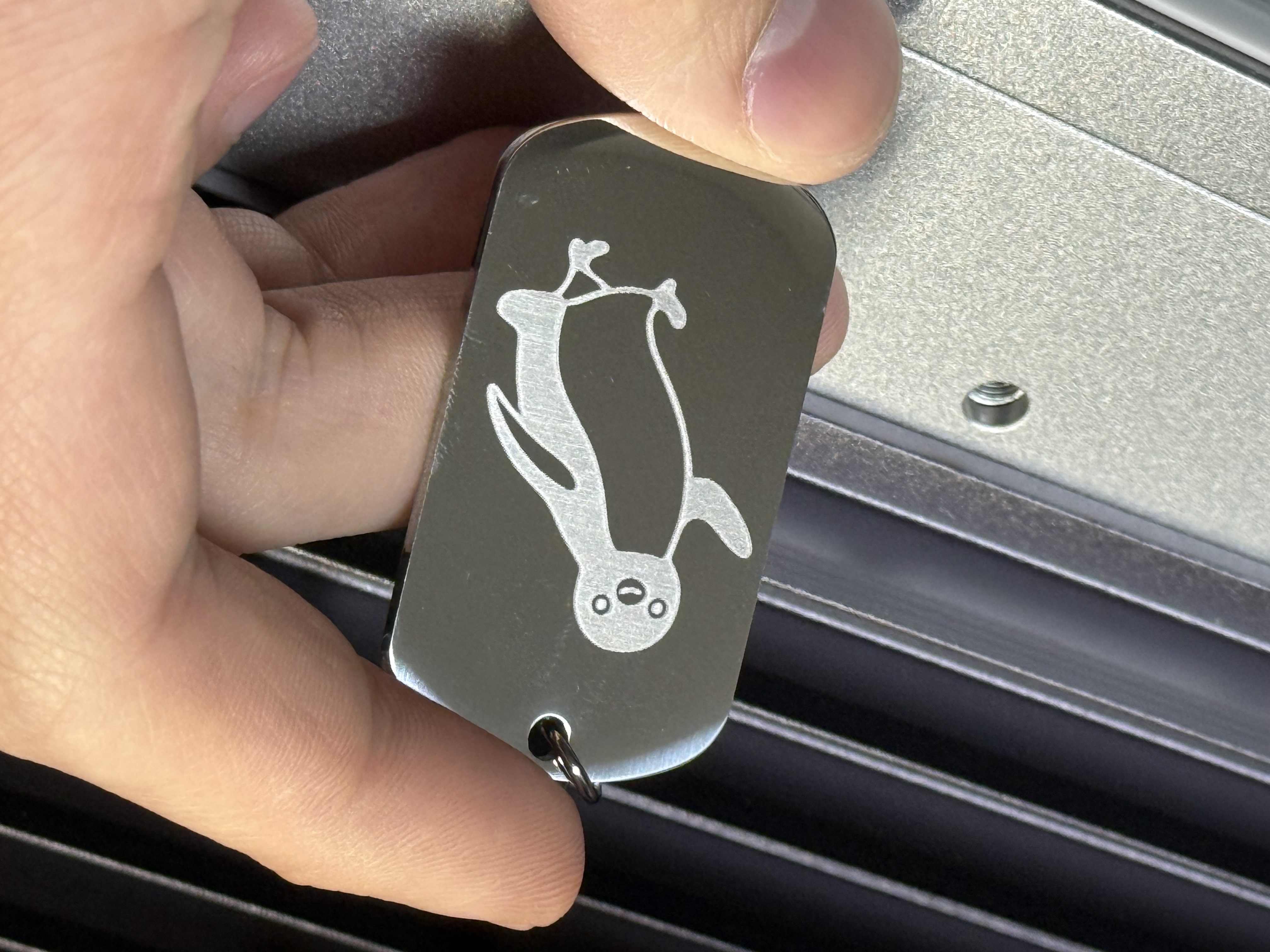
The default speed of 5,000 mm/s is blisteringly fast, and the engraving quality doesn’t suffer at all from this rapid movement of the galvo-driven laser beam. This is one of the most compelling features of the Falcon T1: the ability to make high-quality engravings on metal surfaces in only a few seconds with absolutely no prep work required. The 20W fiber laser is also capable of deeper engravings on metal, stone, and other materials, but the quick engraving is a very compelling feature.

Using the Falcon Design Space default settings, I engraved a dual-layer PU patch for a two-year work anniversary, which took just under 5 minutes. This dual-layer material looks great after a single pass, and the text is clear and legible against the darker top layer. The overall speed of the galvo system is a refreshing change from the lower-cost gantry-driven diode lasers, which operate at a fraction of the speed.
3D Engraving on Slate with the 20W Fiber Laser
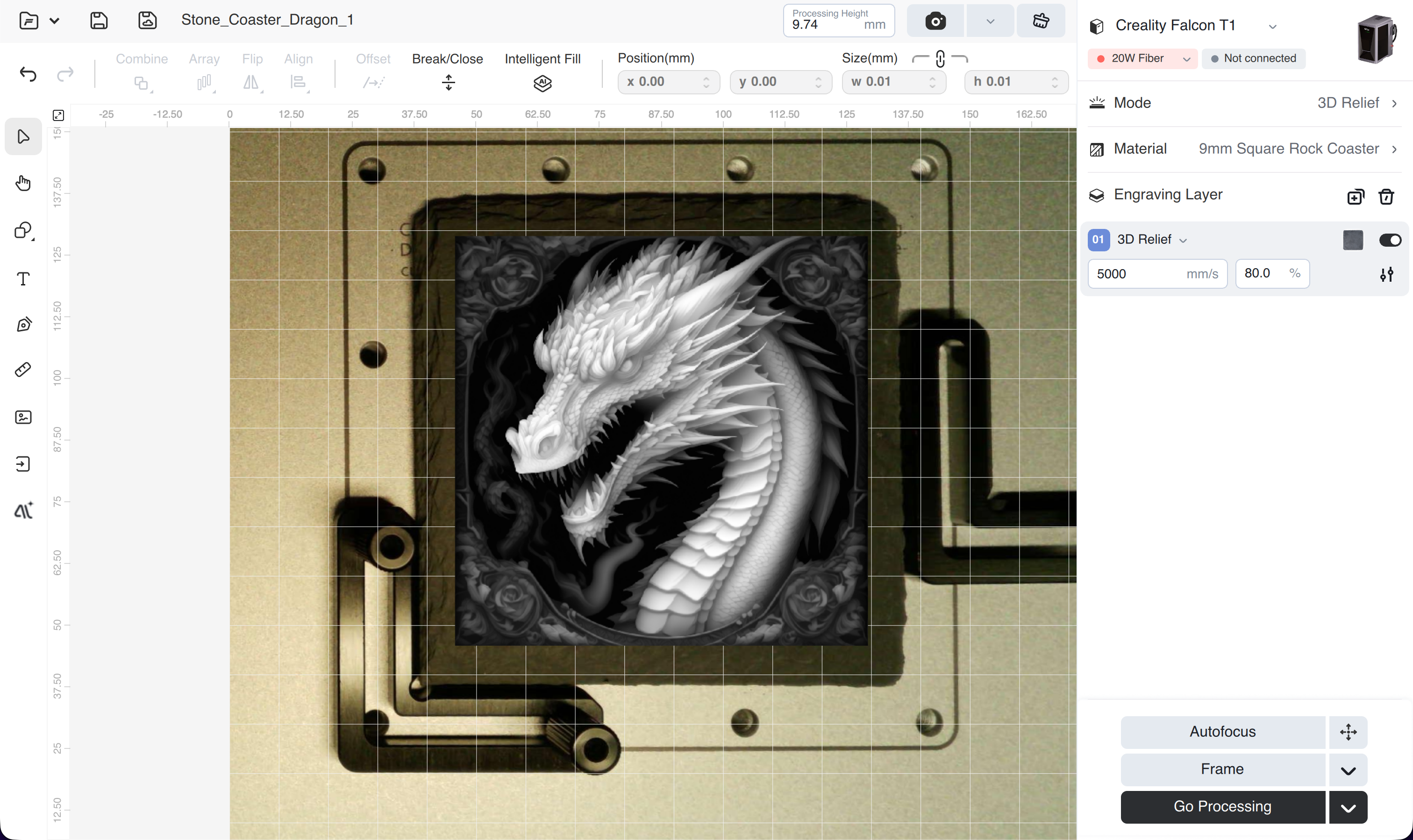
The Creality Falcon T1 offers a 3D Relief mode that can create models typically associated with subtractive manufacturing, such as CNC milling. This mode will engrave thousands of layers away from an object to create a model with a deep relief that has a 3D shape. The Falcon Design Suite software has an integrated tool that allows users to upload an image and convert it to a depth map suitable for an engraving. Using one of the provided images, I went through the process to create a stone coaster with a 3D relief using the 20W fiber laser.
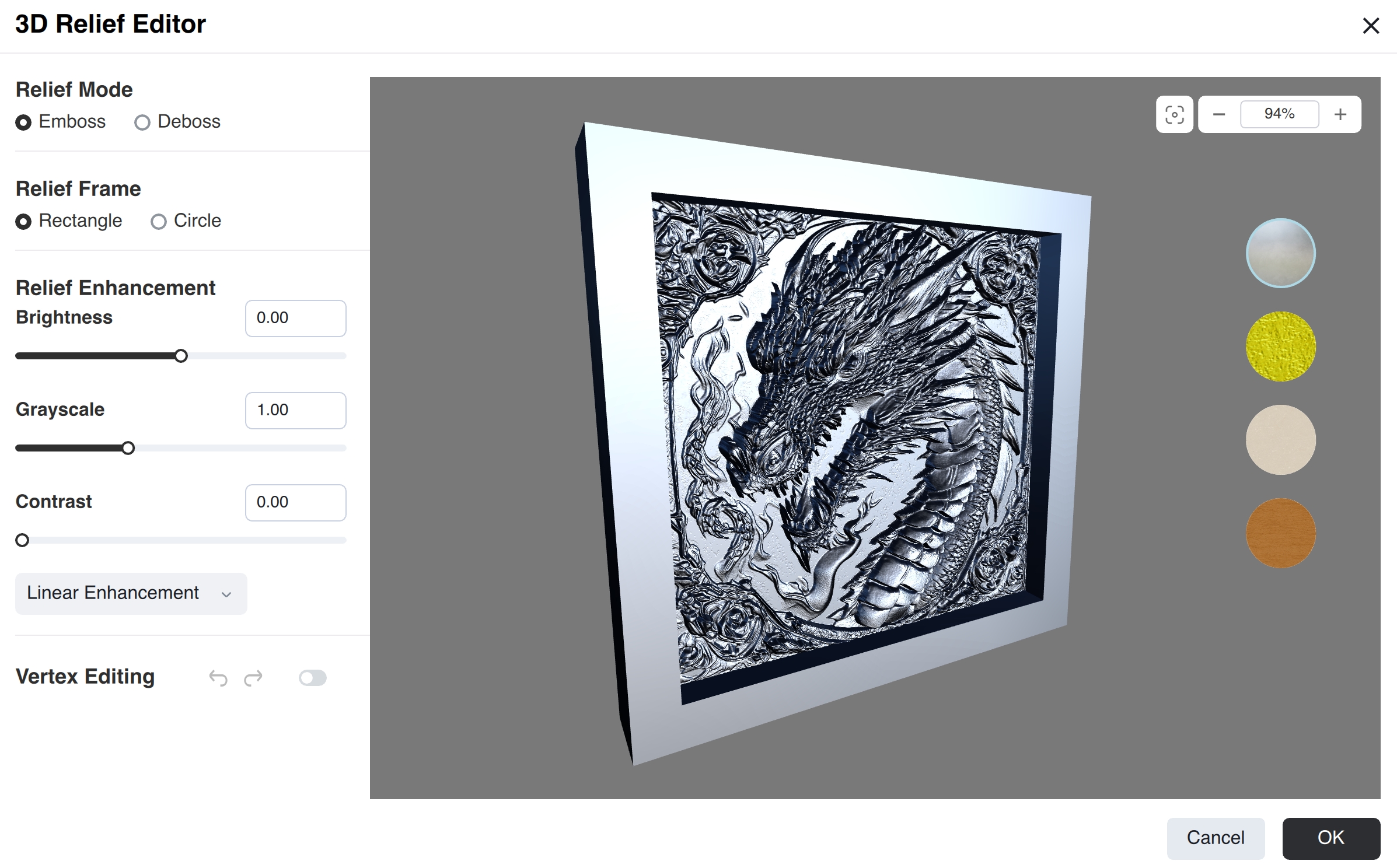
Once the image has been prepared, the 3D Relief Editor mode gives users more granular control over the engraving. The direction of the relief (emboss vs. deboss), the shape of the frame, and image adjustments are all fast and responsive, and the 3D preview mode instantly updates to show the impact of these changes. This was a surprisingly simple process, and I wound up using the default settings for my first 3D relief.
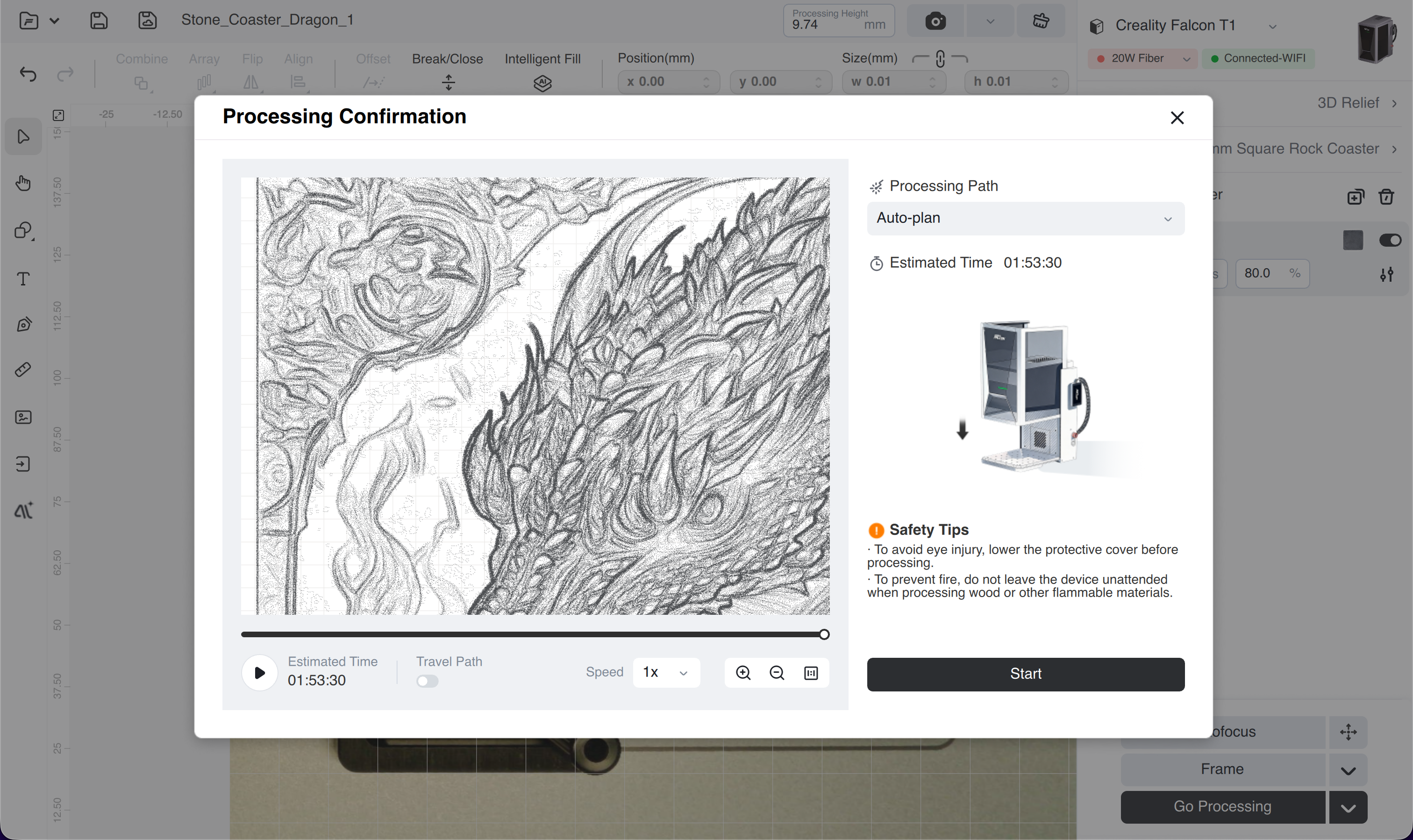
In 3D Relief mode, the Processing Preview in Falcon Design Space will look familiar to anyone who has used a 3D printer, with a series of contours on each layer stacked vertically to form the final model. This preview shows the path of the laser on each layer as well as an estimated processing time. For the 3D relief on this slate coaster, the original estimate was 1:53:30 but the final processing time wound up being 2:35:41.
Image 1 of 2
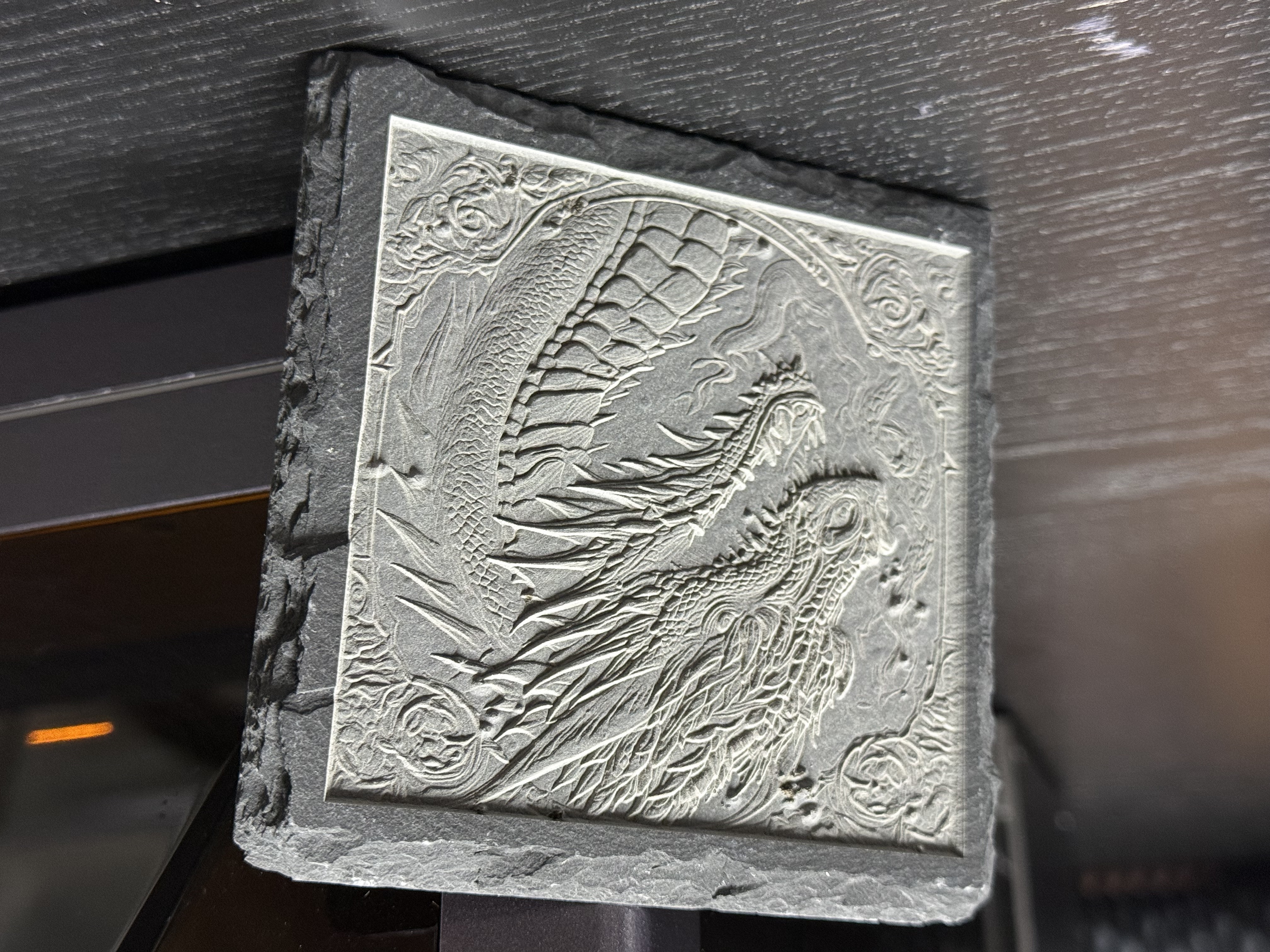
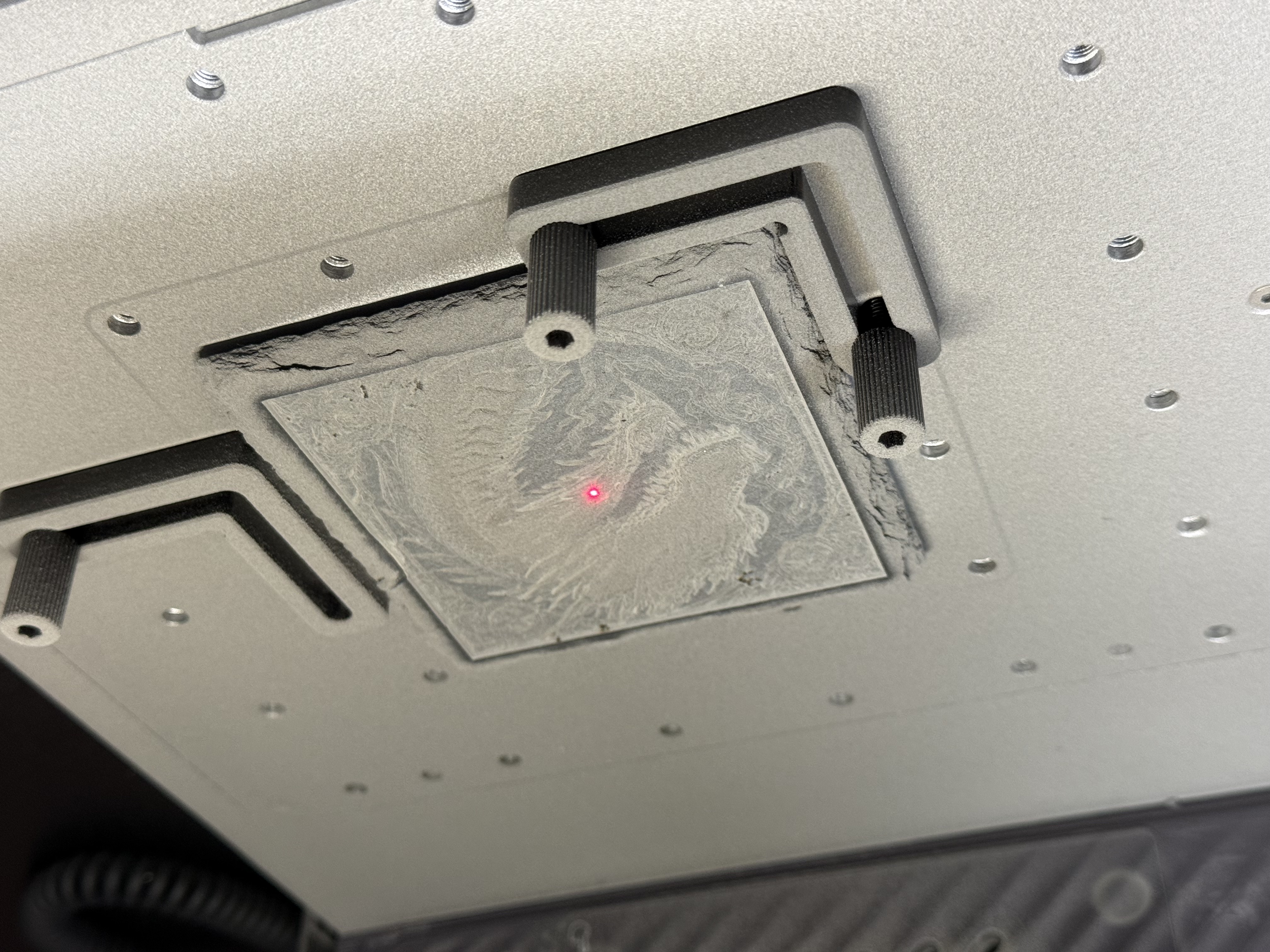
The 3D relief looked incredible, and even the finest detail resolved on the slate coaster. Doing a deep engraving on a slate coaster creates a lot of dust, so I ran the AP1 Mini at max speed for this job. Even with the purifier running at the maximum setting, there was still quite a bit of dust to clean up inside the Falcon T1.
3D Engraving in Crystal with the 5W UV Laser
Image 1 of 2
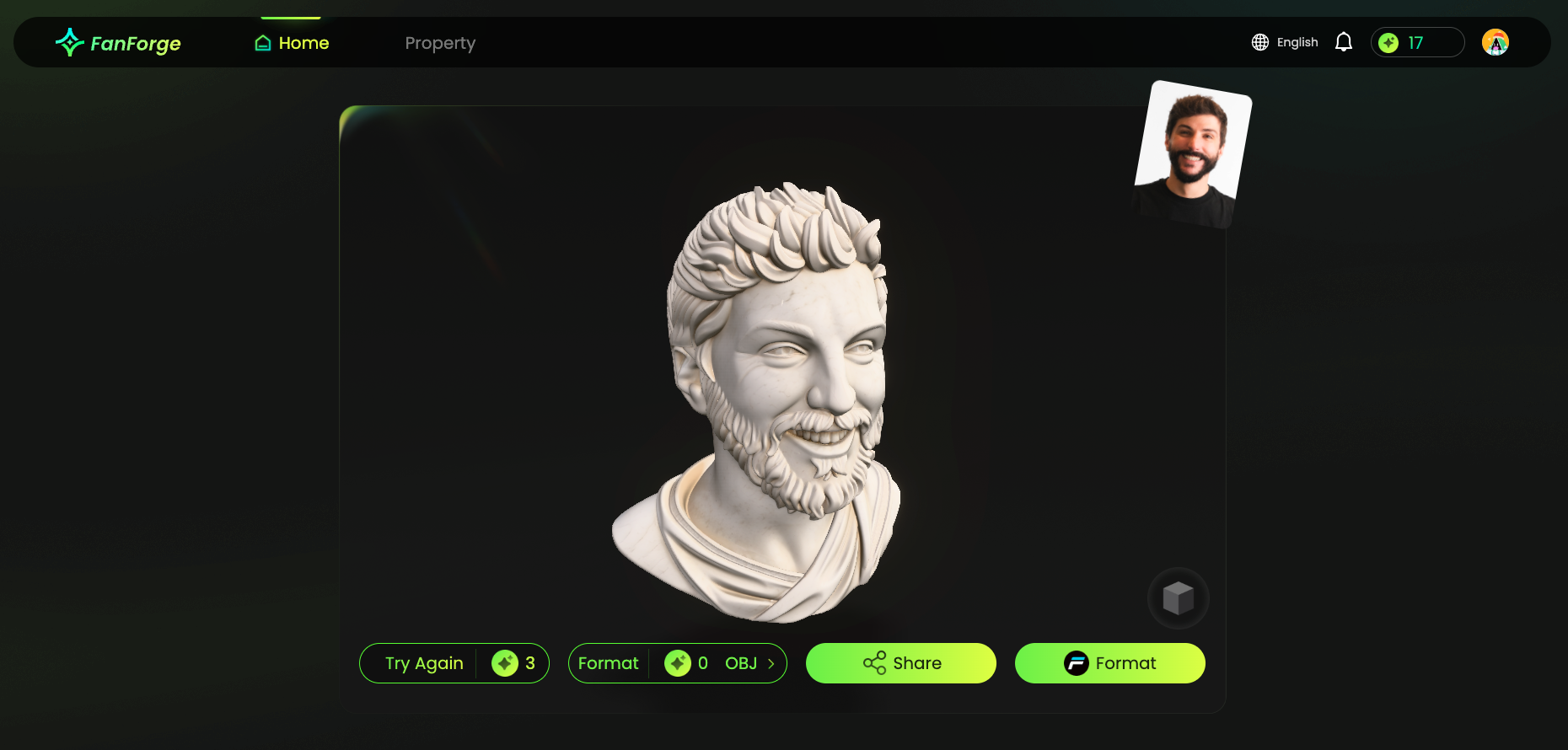
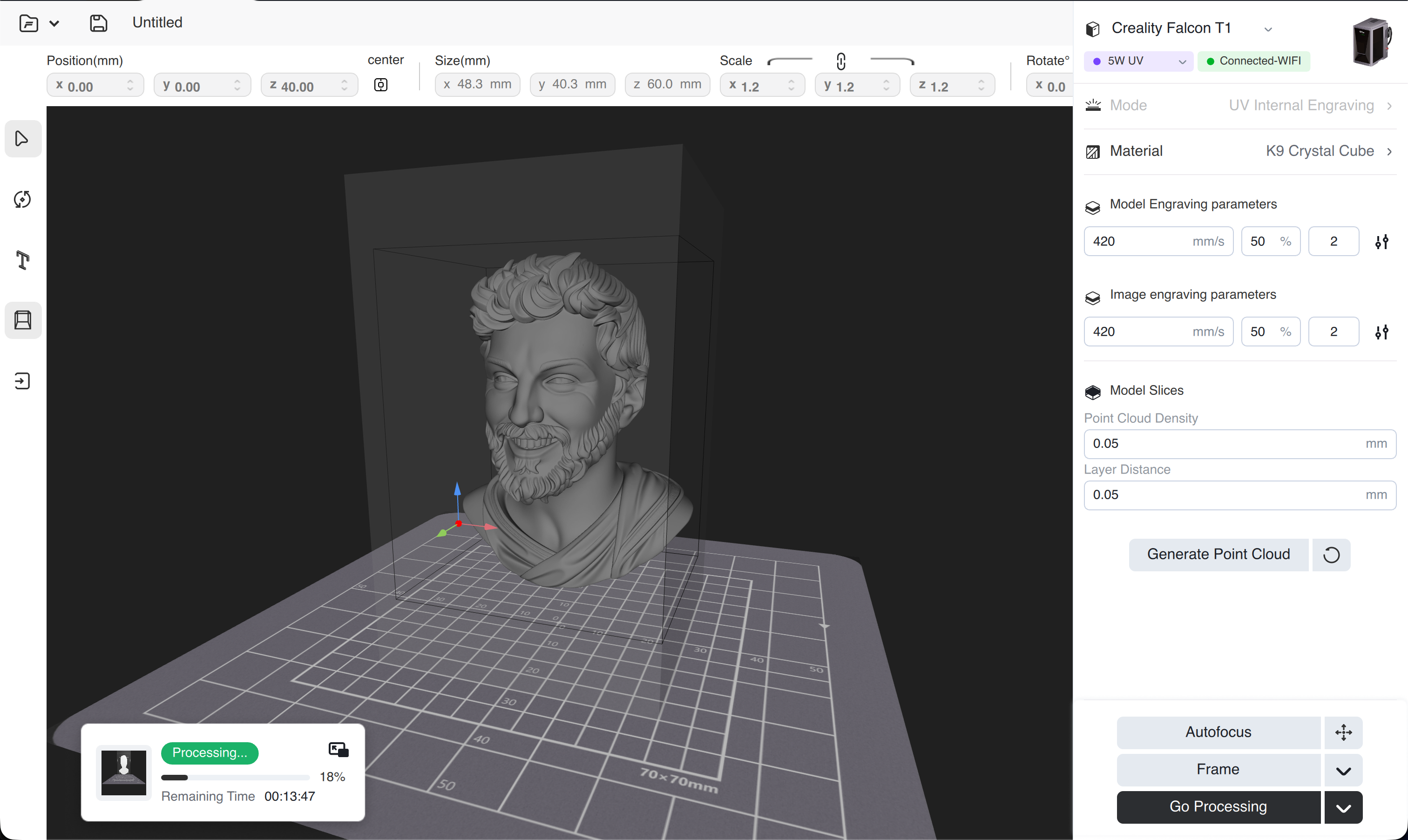
Creality has advertised the AI features of the Falcon Design Space heavily, but using them is a bit of a mixed bag. Using a headshot of myself with a clean background as a prompt, the resulting 3D model had me inexplicably in a toga and generally looked unimpressive. However, it did create a watertight 3D model, which is what’s required for the UV laser to engrave into a crystal. When using Falcon Design Space, I was only able to scale the model in increments of 10% (for example: 1.0, 0.8, 1.5), which was a frustrating experience when trying to align the model with the crystal. Using the special UV engraving mode in the software, I prepared the build and then set the Falcon T1 up for crystal engraving.
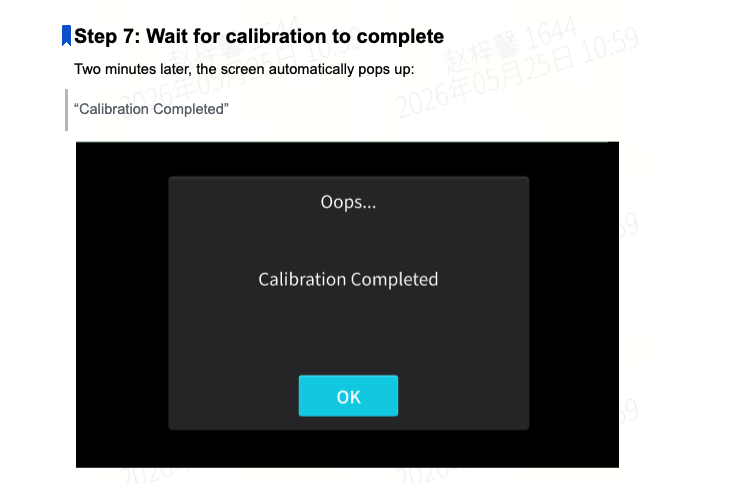
Installing the UV laser module is a bit more complicated than switching between the fiber and diode modules. Most of the Falcon T1 documentation is on a publicly accessible wiki, but the calibration for the UV module is spread across three Word documents that total an eyebrow-raising 57 pages. This calibration documentation is helpful, but much of it was watermarked with a stamp from around the day I had requested it, which made it appear unfinished and rushed. Considering the price of the UV module (over $2,000), I would have expected this calibration documentation to be a bit more presentable.
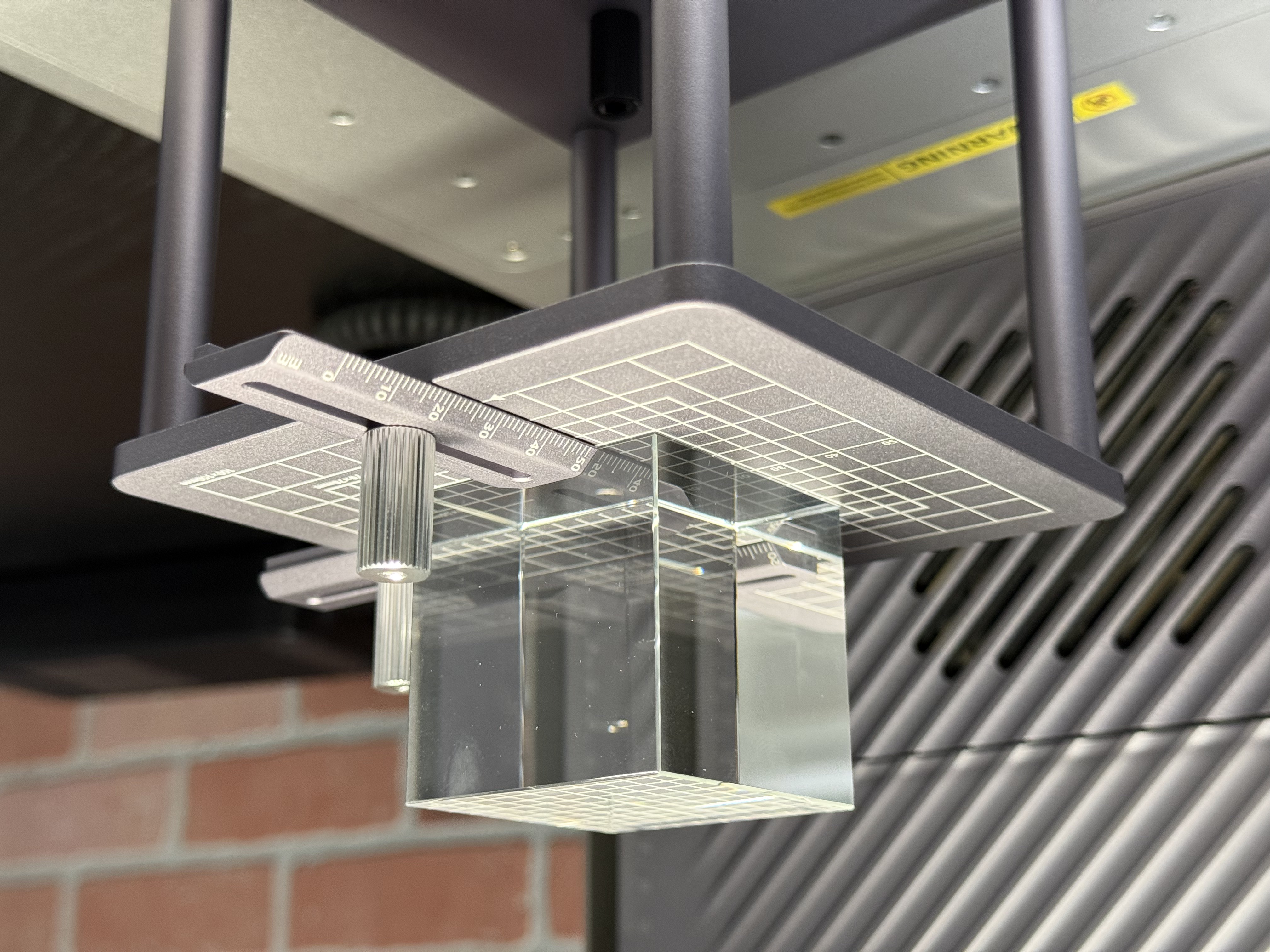
Switching from the fiber laser module to the UV module involves replacing the module, replacing the field lens with the F-Theta field lens, calibrating the laser, and calibrating the F-Theta field lens. Creality sent two lenses for the UV module: one for internal 3D engravings and one for flat engravings. The process to switch out the parts and calibrate took about 30 minutes and required two sheets of calibration paper to be used, something to consider if you plan on swapping between modes frequently.
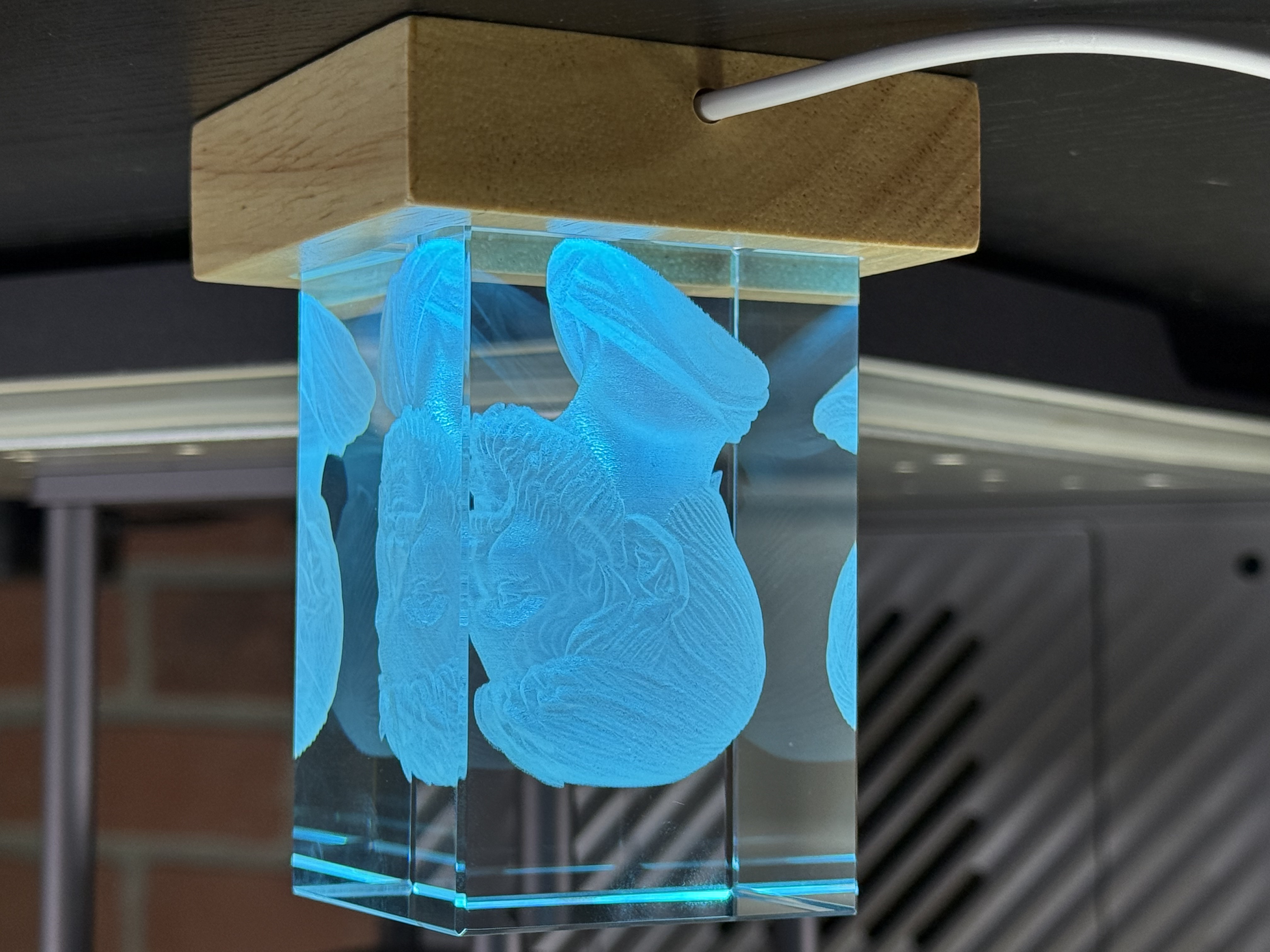
Overall, the crystal looked as expected and would be perfect for presenting to a sales manager who just surpassed a quarterly quota. The engraving time was accurate (about 12 minutes), and the default settings worked well. I had some issues with alignment, and the model was positioned much lower in the volume than I was expecting based on the layout in Falcon Design Space. Engraving other objects had the same issue, which made me wish for a way to generate a 3D bounding box to visualize where the engraving will land in the crystal.
Conveyor Belt / Rotary Attachment Engraving with the Creality Falcon T1
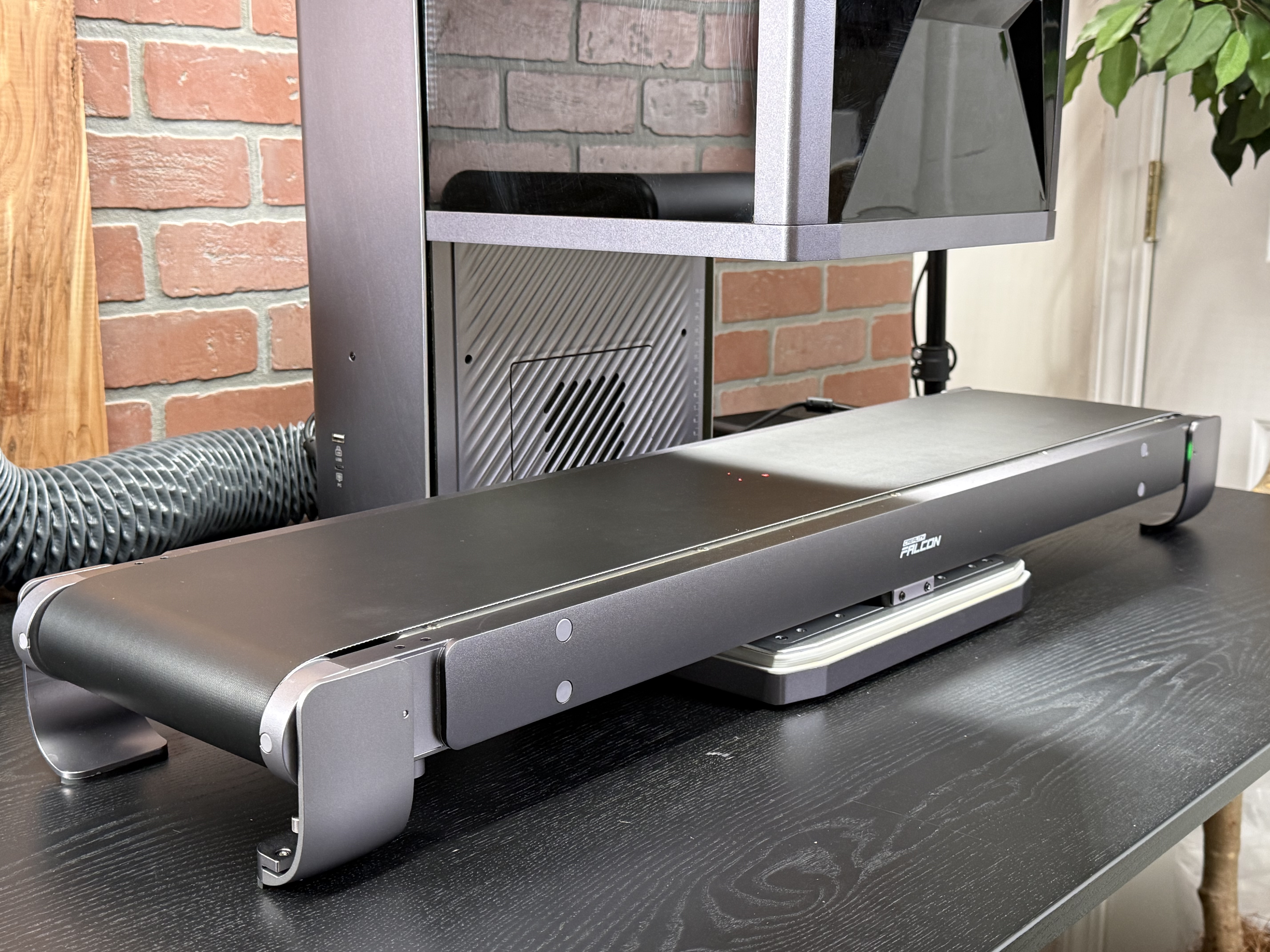
Creality offers a conveyor belt attachment for the Falcon T1 which can be used for engraving parts longer than 175mm or batch engraving many small parts sequentially. The $459 optional accessory attaches to the work area using a few bolts and connects directly to the T1 for communication and power. When using the conveyor belt, the lid needs to be kept slightly open which can allow smoke and light to escape. With the lid open, the Falcon T1 should be treated as an exposed Class 4 laser system, so safety goggles, ventilation, and general caution should be exercised when using the conveyor belt.
Image 1 of 2
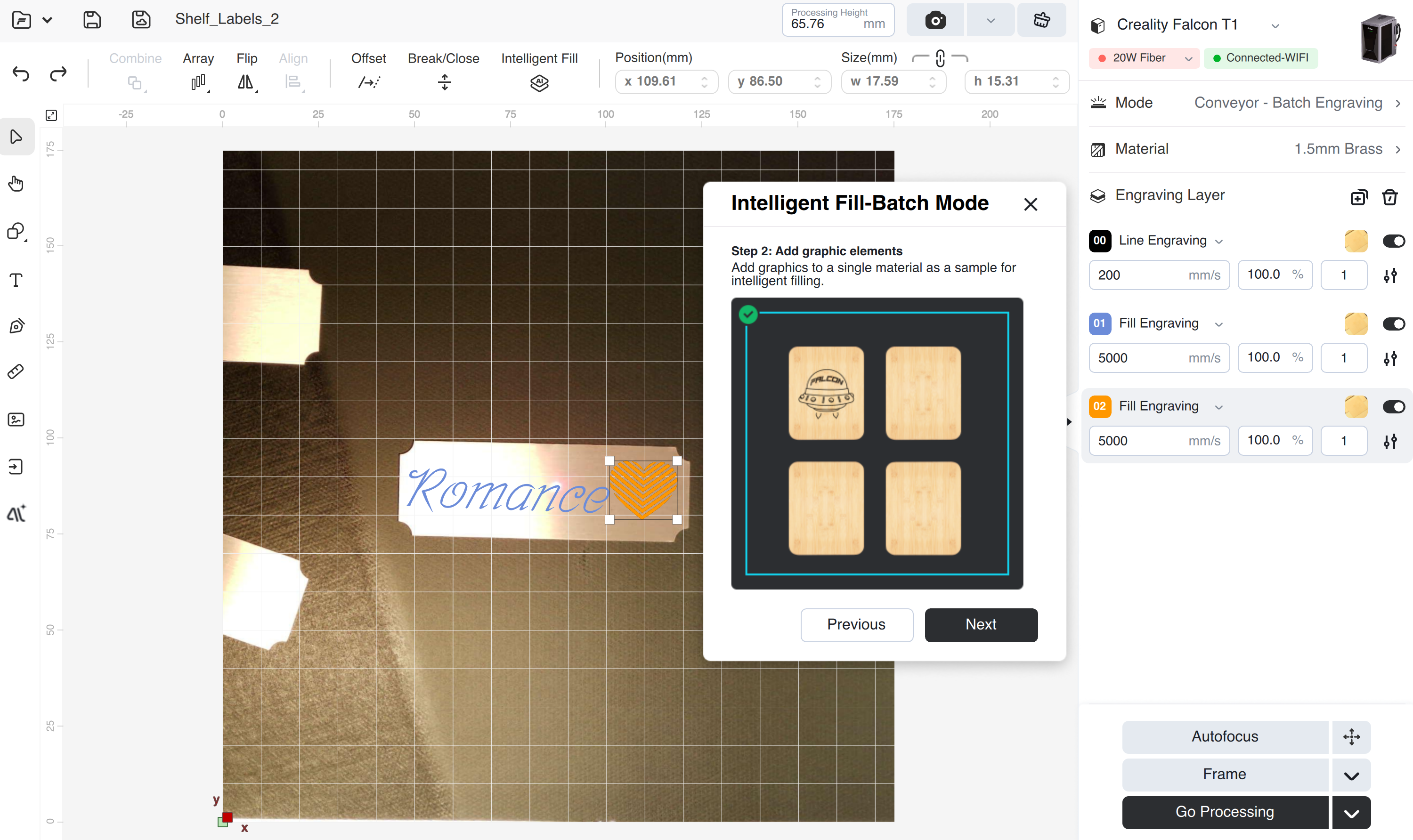

Falcon Design Space has a specific workflow for the conveyor belt that involves selecting a design, aligning it on a workpiece, and then entering batch processing mode. I recently purchased a set of bookshelves for my wife’s ever-growing collection of books, and creating genre plaques for the shelves was a perfect batch-processing test. The batch processing mode has a few restrictions: only one design can be engraved, only one material profile per job, and settings can’t change between parts.
Image 1 of 2
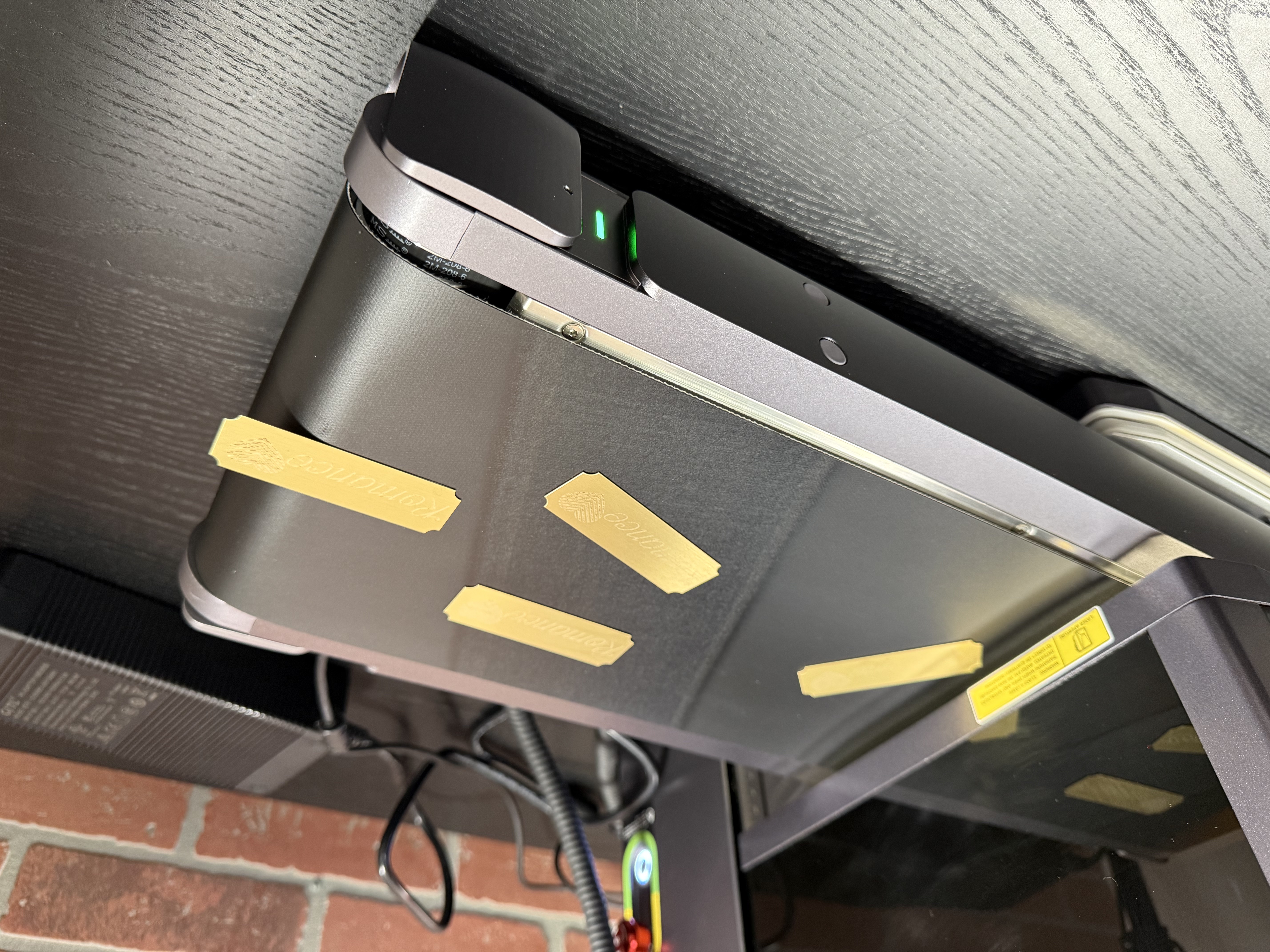
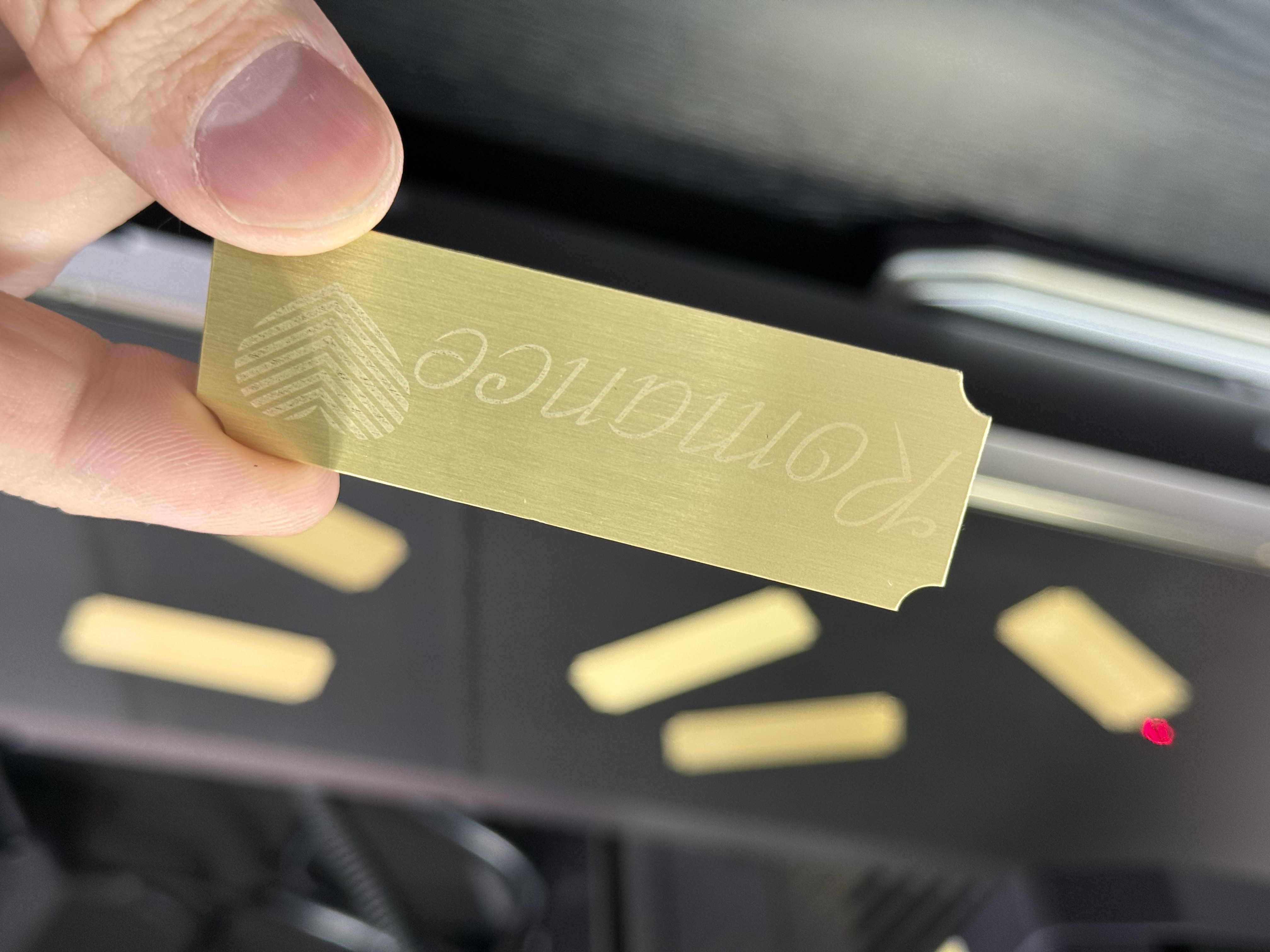
Each of the bookshelf plaques took about 23 seconds to engrave with the 20W fiber laser in a single pass at the default speed of 5,000 mm/s and 100% power. After each part was completed, the conveyor belt would advance a few inches, pause, and take a picture, and then scan for another part to engrave. As the parts completed, they would roll off the edge of the conveyor and hit the table with a satisfying click sound. My only criticism of the belt is the symmetrical design: having a shorter edge to the right of the unit would allow for more belt area for parts to process on the left of the unit without impacting the cost or size of the accessory.
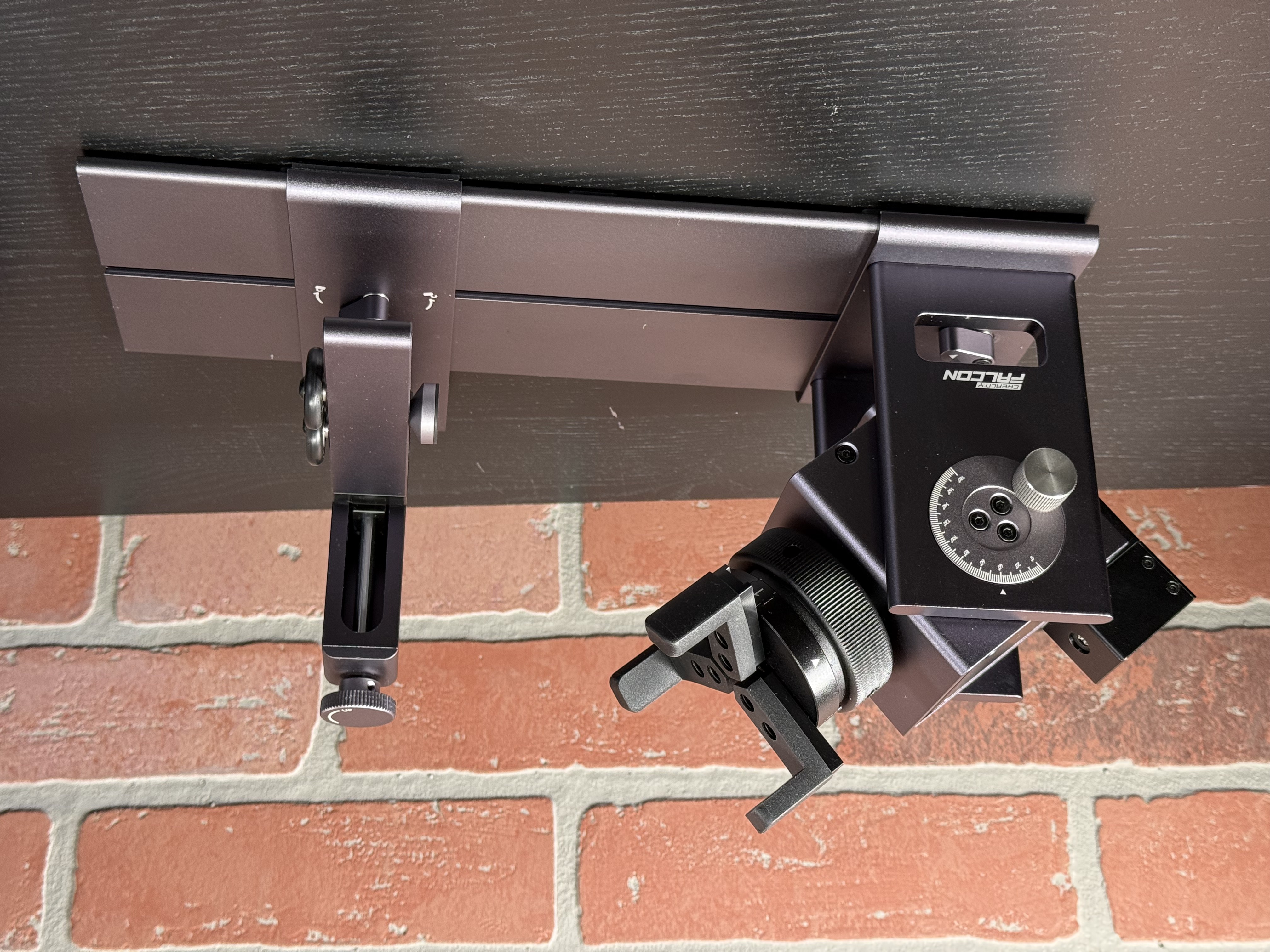
Creality also sent a rotary attachment for the Falcon T1, but pricing and a launch date had not been announced as of this review. The optional rotary accessory includes two modes: chuck and roller. The chuck rotary uses an adjustable chuck mechanism for engraving things like rings, mugs, and other objects that are gripped from the inside or outside. The roller mode is for cylindrical objects, and has an adjustable width for accommodating various size objects.
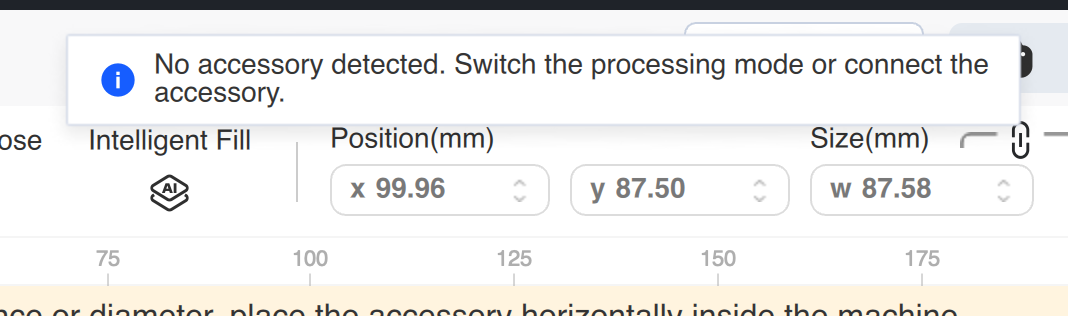
During testing, I was not able to get the Falcon T1 to recognize the chuck rotary and always got the same error message when trying to connect. The motor used for the chuck and roller mode is the same, so this was an unusual problem and Creality was not able to fix it for this review. Creality does not have US-based support for this engraver, so I had to schedule a call with their China-based technical team at 10 PM. The issue was not resolved on the call, and Creality wasn’t able to fix it despite updating the software and spending several days on back-and-forth troubleshooting. For a small business that has a backlog of orders, this lack of urgent support is going to be a critical issue.
Bottom Line

The Creality Falcon T1 has clear potential to be an “all-in-one” laser for prosumer workshops, but seeing messages like “Oops… Calibration Completed” on the LCD gave me the impression that I was beta-testing a nearly-finished piece of hardware instead of a retail-ready prosumer manufacturing tool. The 175 x 175 mm engraving area of the Falcon T1 didn’t feel cramped at all while I was using it, and the high-speed galvo system meant most 2D engravings were completed in under a few minutes when using the 40W diode or 20W fiber laser.
The Falcon T1 is an impressive machine, but it suffers from an incomplete and confusing product rollout. Originally announced at CES 2026, the Falcon T1 is becoming available for order as of the writing of this review (May 2026), with the UV and MOPA modules following a staggered rollout instead of launching alongside the Falcon T1. Creality claimed the unit sent to me was a production unit, but the lack of a shipping date for additional modules, issues with customer support, and limited accessories available on the site are going to be a concern to serious power users who will rely on Creality for support.
The modular nature of the Falcon T1 lends itself to users who have varying interests or entrepreneurs with flexible business needs. I’ve frequently seen kiosks in shopping malls that engrave crystals with an image while you wait, and wondered about the commercial viability of the business model due to the high cost of the industrial laser required. The prosumer Falcon T1 is a laser that is capable of making these engravings without being locked into that single application, and can easily pivot to engraving dog tags, slate coasters, and other small products.
The Falcon T1 is not a cheap laser: buying the unit, all accessories, and starter materials can easily exceed $10,000. If you want a fast galvo laser to start making products today, the 20W fiber and 40W diode lasers are impressive and should serve that need well. If your decision hinges on the UV or MOPA modules, the Falcon T1 may be a laser engraver worth watching instead of buying immediately.
If you’re looking for a laser to get started with making custom products, the less expensive WeCreat Lumos offers a similar galvo laser setup but has a smaller volume and less powerful laser. The xTool F2 Ultra (one of the best laser engravers) offers a similar experience and has a MOPA laser for color engraving, something Creality advertises for the Falcon T1 but has yet to ship.